
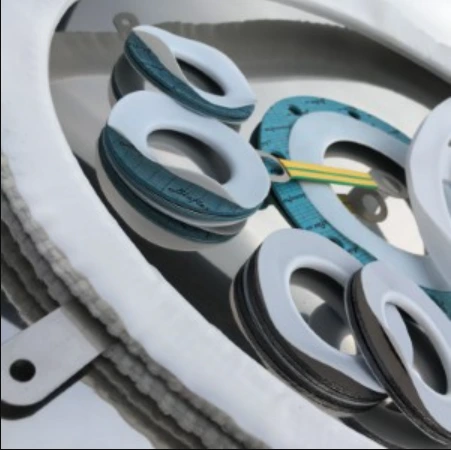
PTFE envelope gaskets are engineered sealing solutions designed for corrosive, high-purity, and temperature-sensitive industrial applications. They combine the chemical inertness of PTFE with the mechanical strength of a core insert, making them suitable for flanged connections where conventional elastomer or fiber gaskets fail.
In industries such as chemical processing, pharmaceuticals, food production, and petrochemicals, sealing reliability is critical. A gasket must resist chemical attack, maintain dimensional stability under bolt load, and prevent leakage even under thermal cycling. PTFE envelope gaskets are specifically developed to meet these requirements.
What Is a PTFE Envelope Gasket?
A PTFE envelope gasket consists of two components:
- An outer PTFE jacket (envelope)
- An inner core insert for structural reinforcement
The PTFE outer layer is in direct contact with the process media. This layer provides exceptional chemical resistance and prevents contamination. The internal core provides compressibility and mechanical strength to ensure effective sealing under bolt load.
Unlike solid PTFE gaskets, envelope gaskets improve load-bearing performance while retaining chemical inertness.
Construction and Design
The envelope may be molded or machined from virgin PTFE, while the insert core may be made from:
- Compressed fiber
- EPDM
- Nitrile rubber
- Expanded PTFE
- Metal insert (for higher mechanical strength)
Construction Overview
|
Component |
Purpose |
|
PTFE Outer Jacket |
Chemical resistance, non-stick sealing surface |
|
Insert Core |
Structural support, compression recovery |
| Flange Contact Surface |
Prevents media exposure to insert |
This hybrid construction allows the gasket to be used with:
- Glass-lined flanges
- Cast iron flanges
- Stainless steel flanges
- Carbon steel piping systems
Key Properties of PTFE Envelope Gaskets
PTFE envelope gaskets are selected primarily for chemical resistance, but their benefits extend further.
- Superior Chemical Resistance
PTFE is resistant to almost all industrial chemicals, including strong acids, alkalis, solvents, and hydrocarbons. It is unaffected by corrosive fluids that would degrade rubber or fiber gaskets.
- Wide Temperature Range
PTFE maintains structural stability across a broad temperature range.
|
Property |
Typical Range |
|
Continuous Temperature |
Up to 260°C (500°F) |
|
Chemical Stability |
Excellent |
| Melting Point |
Approx. 327°C |
- Low Coefficient of Friction
The non-stick surface prevents media adhesion and simplifies disassembly during maintenance.
- Minimal Contamination Risk
Because only PTFE contacts the process fluid, it is ideal for pharmaceutical and food-grade systems.
- Excellent Sealing for Low to Moderate Pressure
PTFE envelope gaskets are particularly effective where chemical compatibility is more critical than extreme compressive strength.
Applications of PTFE Envelope Gaskets
PTFE envelope gaskets are widely used in industries that handle corrosive, high-purity, or temperature-sensitive fluids.
Chemical Processing Plants
Used in pipeline flanges, reactors, and storage tanks where aggressive chemicals are transported or stored.
Pharmaceutical and Bioprocessing Equipment
Ensures non-reactive sealing in sterile and contamination-sensitive systems.
Food and Beverage Industry
Used where hygienic, non-toxic sealing materials are required.
Oil & Gas Industry
Suitable for moderate-pressure chemical lines and fluid handling systems.
Glass-Lined Equipment
Often preferred for glass-lined steel flanges because they prevent flange surface damage and corrosion.
Advantages Over Conventional Gaskets
Traditional gaskets made from rubber, graphite, or compressed fiber may degrade under chemical exposure or lose bolt load due to creep. Metal gaskets may corrode or fail to accommodate flange irregularities.
PTFE envelope gaskets provide a balanced performance profile.
|
Comparison Factor |
PTFE Envelope | Rubber Gasket | Fiber Gasket |
|
Chemical Resistance |
Excellent | Moderate | Moderate |
|
Temperature Handling |
High | Moderate | Moderate |
| Corrosion Resistance | Superior | Limited |
Limited |
| Flange Compatibility | Wide | Limited |
Limited |
| Contamination Risk | Minimal | Possible |
Possible |
Types of PTFE Envelope Gaskets
PTFE envelope gaskets are typically available in different designs:
|
Type |
Description | Application |
|
Type F |
Split PTFE envelope | Standard flanges |
| Type U | Formed PTFE jacket |
Higher load applications |
| Type V | Machined solid PTFE |
Specialty use |
Selection depends on flange type, bolt load, and process conditions.
Design Considerations Before Selection
When selecting a PTFE envelope gasket, evaluate:
- Operating pressure
- Temperature range
- Bolt torque capacity
- Flange surface finish
- Chemical compatibility
- Required service life
Although PTFE offers excellent chemical resistance, it is softer than metal or reinforced composite gaskets. In high-pressure systems, additional reinforcement or alternative gasket designs may be required.
Proper flange alignment and bolt tightening sequence are also critical to prevent uneven compression.
Installation Best Practices
Proper installation ensures long-term performance:
- Ensure flange faces are clean and free of damage
- Apply uniform bolt torque in cross pattern
- Avoid over-tightening to prevent deformation
- Verify gasket alignment before final tightening
Because PTFE has a low friction surface, correct bolt load is essential to prevent gasket slippage.
Final Thought
PTFE envelope gaskets are a specialized sealing solution designed for chemically aggressive and contamination-sensitive environments. By combining a chemically inert PTFE outer layer with a compressible core insert, they provide reliable sealing, extended service life, and corrosion resistance in applications where conventional gasket materials fail.
For industries handling acids, solvents, or high-temperature fluids, PTFE envelope gaskets offer a dependable sealing solution that protects equipment, reduces leakage risks, and ensures operational safety.
As part of reliable O rings and seal applications, they also support long-term performance with minimal maintenance in demanding industrial conditions.