
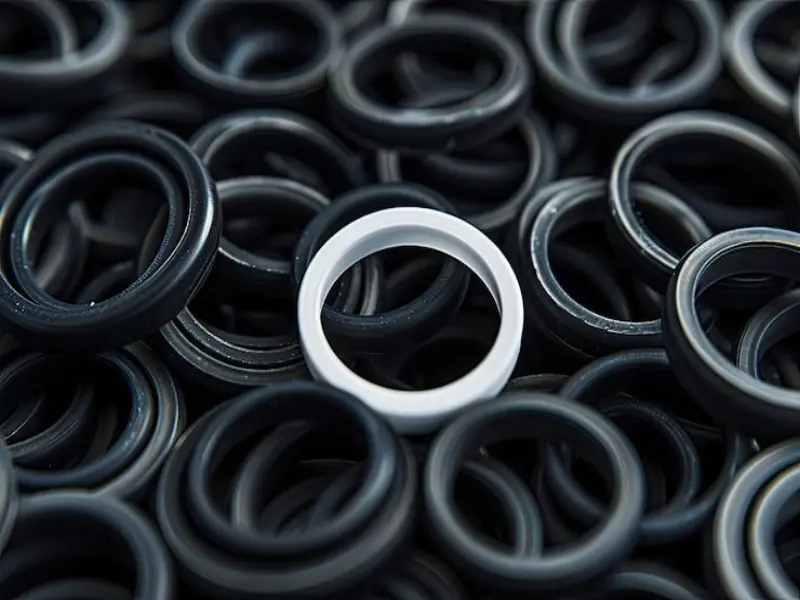
PTFE envelope gaskets are composite sealing elements designed for applications where chemical resistance, purity, and sealing reliability are critical. These gaskets consist of an outer PTFE jacket that completely encloses an internal core insert. The PTFE layer provides corrosion resistance and contamination control, while the insert improves compressibility and mechanical strength.
Because only PTFE comes into contact with the process media, envelope gaskets are widely used in chemical processing, pharmaceutical systems, food-grade pipelines, and glass-lined equipment. Their ability to combine chemical inertness with structural stability makes them suitable for demanding flange connections.
Construction of PTFE Envelope Gaskets
A PTFE envelope gasket is composed of two main components:
- Outer PTFE Jacket (Envelope) – Provides chemical resistance and sealing surface.
- Inner Core Insert (Inlay) – Provides rigidity and load-bearing capability.
The insert material may vary depending on application requirements. Common insert materials include graphite, compressed fiber, EPDM, or rubber.
Construction Overview
| Component | Function |
| PTFE Outer Layer | Chemical resistance, non-stick surface, corrosion protection |
| Core Insert | Structural stability, compression recovery, bolt load support |
| Flange Contact Surface | Prevents media contamination |
This construction makes PTFE envelope gaskets especially suitable for enamel flanges, plastic piping systems, rubber-lined flanges, and steel flanges.
Key Features of PTFE Envelope Gaskets
PTFE envelope gaskets are selected primarily for their chemical resistance, but they also provide several additional performance benefits.
- High Chemical and Corrosion Resistance
PTFE is inert to most acids, alkalis, and solvents, making it ideal for aggressive chemical environments.
- Slow Aging and Brittleness Resistance
Compared to elastomer-based gaskets, PTFE ages slowly and maintains stability over extended service periods.
- Low Surface Pressure Requirement
PTFE envelope gaskets require relatively low seating stress, making them suitable for fragile flanges such as glass-lined or enamel-coated systems.
- Adaptability and Customization
They can be molded or fabricated to match specific flange sizes and irregular surfaces.
- Clean and Contamination-Free Sealing
PTFE prevents chemical interaction and is suitable for FDA-compliant applications in food and pharmaceutical industries.
- Thermal and Electrical Insulation
PTFE provides both thermal stability and electrical insulation properties.
Performance Summary
| Property | Performance Level |
| Chemical Resistance | Excellent |
| Corrosion Resistance | Superior |
| Temperature Stability | High |
| Surface Pressure Requirement | Low |
| Contamination Risk | Minimal |
| Aging Resistance | Slow degradation |
Applications of PTFE Envelope Gaskets
Due to their low leakage rate and chemical inertness, PTFE envelope gaskets are widely used across industries.
- Glass-Lined and Enamel Flanges
Their low seating stress prevents damage to delicate flange coatings.
- Chemical Processing Plants
Used in pipelines carrying corrosive fluids and gases.
- Food and Pharmaceutical Industry
Suitable for FDA-regulated applications due to non-reactive PTFE surface.
- Rubber, Plastic, and Steel Flanges
Compatible with a wide range of flange materials.
- High Temperature and Moderate Pressure Systems
Capable of performing reliably under elevated temperatures with proper bolt loading.
- Applications Requiring Cleanliness and Purity
Ideal for systems where contamination must be avoided.
Advantages Over Conventional Gaskets
Traditional rubber or fiber gaskets may swell, crack, or degrade when exposed to aggressive chemicals. Metal gaskets may lack flexibility or cause flange damage in fragile systems.
PTFE envelope gaskets offer a balanced solution.
| Comparison Factor | PTFE Envelope Gasket | Conventional Rubber | Fiber Gasket |
| Chemical Resistance | Excellent | Moderate | Moderate |
| Contamination Risk | Very Low | Possible | Possible |
| Flange Protection | High | Moderate | Moderate |
| Long-Term Stability | Strong | Limited | Limited |
Important Selection Considerations
Although PTFE envelope gaskets offer excellent chemical resistance, they are best suited for low to moderate pressure applications. For high-pressure environments, reinforced PTFE or alternative gasket designs may be required.
Key factors to evaluate before selection include:
- Operating pressure
- Temperature range
- Bolt torque capacity
- Flange surface finish
- Media compatibility
- Required service life
Proper installation and uniform bolt tightening are essential to ensure effective sealing performance.
Choosing a Reliable O Rings and Seal Manufacturer
Selecting the right O rings and seal manufacturer is important for ensuring consistent quality, dimensional accuracy, and reliable sealing performance. A trusted manufacturer can provide suitable gasket materials, customized sizes, and sealing solutions based on pressure, temperature, chemical exposure, and application requirements. Working with an experienced supplier also helps ensure that the selected seals meet the required industry standards and performance expectations.
Conclusion
PTFE envelope gaskets provide a reliable sealing solution for corrosive, high-purity, and temperature-sensitive applications. Their composite design combines the chemical inertness of PTFE with the structural support of an insert core, ensuring effective sealing across a wide range of flange materials.
For industries requiring corrosion resistance, contamination control, and long service life, PTFE envelope gaskets remain a dependable and cost-effective sealing option.
Partnering with a trusted O rings and seal manufacturer ensures the right gasket selection, consistent quality, and long-term performance across demanding industrial applications.