
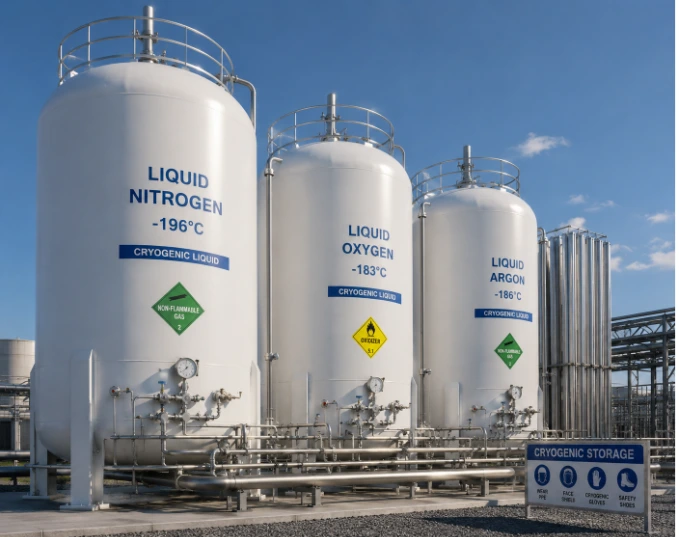
From LNG storage terminals to liquid hydrogen pipelines, cryogenic systems push equipment to its limits. This guide explains why precision sealing is the critical link that holds it all together.
The Challenge of Cryogenic Industrial Systems
Modern industrial facilities handling liquefied gases operate in some of the most demanding conditions on earth. Cryogenic storage tanks hold liquefied gases such as liquid nitrogen (LIN), liquid oxygen (LOX), liquid argon (LAR), LNG, and liquid hydrogen (LH2) at temperatures ranging from -73°C all the way down to -271°C. At these extremes, every component in the system tanks, pumps, valves, pipework, and connections faces immense mechanical and thermal stress.
What keeps these systems safe and leak-free is not just the engineering of the vessels themselves, but the precision sealing at every joint, port, valve stem, and pump interface. A failed seal in a cryogenic system does not just mean downtime it can mean catastrophic pressure loss, contamination, or a safety incident involving volatile or asphyxiating gases.
For engineers and procurement teams responsible for these systems, understanding how sealing solutions behave in cryogenic environments and what to specify is essential.
Cryogenic Storage Tanks — Where Sealing Demands Begin
Industrial cryogenic storage tanks are vacuum-insulated double-wall vessels designed to keep stored cryogens at stable low temperatures while minimising boil-off. They range from small microbulk units at customer sites to large bulk storage tanks used at gas production plants, hospitals, industrial facilities, and LNG terminals.
Common Tank Types and Their Sealing Needs
The sealing requirements vary significantly based on the tank type, stored medium, and operating pressure
| Tank Type | Stored Media | Temperature Range | Key Sealing Challenge |
| Bulk Storage Tanks | LIN, LOX, LAR, LCO2, LNG | -196°C to -162°C | Thermal cycling at nozzle connections and valve ports |
| Microbulk Units | LIN, LOX, LCO2 | -196°C to -183°C | Frequent fill/empty cycles stressing O-ring grooves |
| Transport Tanks (ISO / Road Tankers) | LIN, LOX, LAR, LNG, LH2 | -196°C to -253°C | Vibration combined with extreme cold at valve stems |
| Liquid Hydrogen Tanks | LH2 | -253°C | Widest temperature range; hydrogen embrittlement risks |
| LNG Storage & Distribution | LNG | -162°C | High pressure combined with sub-zero temperature |
| Cryo-Bio Containers | LN2 | -196°C | Sterility, leak-tightness for biological sample storage |
Each tank has multiple sealing points inlet/outlet nozzles, pressure relief valve connections, level gauges, fill ports, and vacuum interspace valves. Standard elastomeric O-rings fail at these temperatures. Specially engineered cryogenic sealing solutions are required at every one of these interfaces.
Why Standard O-Rings Are Not Suitable for Tank Sealing
Standard rubber or elastomeric O-rings rely on material elasticity to maintain contact pressure and seal effectiveness. At cryogenic temperatures, most elastomers stiffen dramatically, lose their compressive recovery, and can crack. Even silicone O-rings which perform down to -60°C are inadequate for many cryogenic tank applications where temperatures fall far below this threshold.
The consequences include micro-leaks at nozzle flanges, failure at pressure relief valve seats, and loss of vacuum integrity at instrumentation ports. In oxygen service, a leak can also introduce a serious fire hazard. In hydrogen service, the risk of ignition is significant.
Cryogenic Pumps — Sealing the Moving Heart of the System
Cryogenic liquid transfer requires specialised pumps designed to handle extremely cold, low-viscosity fluids without cavitation, leakage, or material failure. Centrifugal cryogenic pumps and submerged pumps are used to transfer liquefied gases between storage vessels, into transport tankers, and directly to vaporiser systems for end-use.
Sealing Challenges Specific to Cryogenic Pumps
Pumps introduce additional sealing complexity compared to static tank connections because components are in motion:
- Shaft seals and mechanical seals must maintain integrity while rotating at speed in a -196°C or colder fluid environment.
- Thermal gradients between the cold pump body and the ambient-temperature drive motor create differential expansion that seals must accommodate.
- Low-viscosity cryogenic liquids have very poor lubrication properties, making seal face wear a critical design consideration.
- Pump start-up and shutdown generate thermal cycles that repeatedly stress and relax sealing materials.
- In oxygen pump applications, any seal material must be compatible with LOX eliminating hydrocarbon-based elastomers entirely.
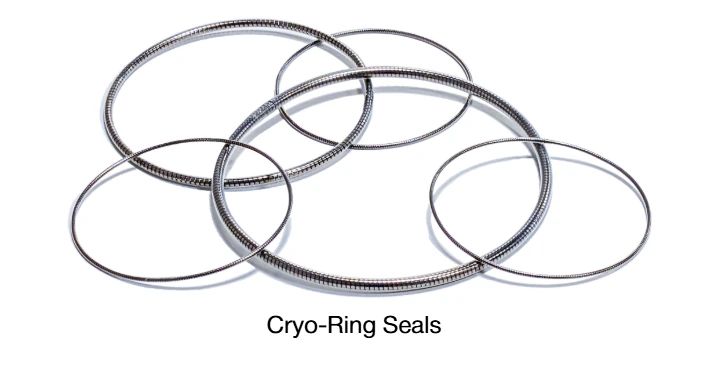
For cryogenic pump mechanical seals, the face materials, spring materials, and secondary seals (including O-rings at static locations) must all be selected for low-temperature performance. Stainless steel spring-energised seals encapsulated with FEP or PFA such as the Cryo-Ring™ series are a proven solution for static secondary sealing at pump inlet flanges, vent connections, and instrument tapping points on pump housings.
Seal Material Compatibility in Pump Applications
| Application | Fluid | Recommended Seal Type | Why |
| Pump shaft secondary seal | LIN / LOX / LAR | Cryo-Ring™ FEP/PFA | Operates to -250°C; no cold flow; LOX compatible |
| Pump inlet flange O-ring | LNG | Cryo-Ring™ FEP/PFA | Resists thermal cycling; maintains contact pressure |
| Pump housing instrument port | LH2 | Cryo-Ring™ PFA grade | PFA rated to -250°C; hydrogen-compatible |
| Pump discharge valve seal | LCO2 | Cryo-Ring™ FEP grade | CO2-resistant encapsulation; stable at low temp |
Cryogenic Valves — The Most Sealing-Critical Component
Of all the components in a cryogenic system, valves experience the most demanding sealing conditions. A cryogenic valve must seal the flow path when closed, prevent stem leakage when open, and survive thousands of open/close cycles across its service life all while operating at temperatures far below -100°C.
Valve types used in cryogenic systems include ball valves, globe valves, check valves, butterfly valves, safety relief valves, and extended-bonnet valves. The extended bonnet design is particularly important: it keeps the packing and gland assembly at a warmer temperature than the valve body, protecting standard packing materials from the worst of the cold.
Where Seals Are Critical in Cryogenic Valves
Every cryogenic valve contains multiple sealing interfaces, each with specific requirements:
- Seat seals — prevent flow-through leakage when the valve is closed. Must maintain tight contact under thermal contraction.
- Stem seals / packing — prevent leakage along the valve stem. Must accommodate stem movement while sealing.
- Body-to-bonnet seals — flange gaskets or O-rings at the joint between valve body and bonnet.
- End connection seals — at flanged or socket-welded connections to pipework.
- Instrument / vent port seals — small-diameter seals at gauge, bleed, or instrument tapping points on the valve body.
Each of these locations has historically been a source of failure when standard sealing materials are used. The solution across all of them is the consistent application of cryogenic-grade sealing materials that retain flexibility, resist cold flow, and maintain dimensional stability from installation temperature down to operating temperature.
Valve Sealing Across Industry Applications
| Industry / Application | Valve Type | Media | Seal Requirement |
| LNG Terminal Loading Arms | Ball / Butterfly Valve | LNG (-162°C) | Seat and stem seals rated for methane service at sub-zero temp |
| Liquid Hydrogen Fuelling Station | Globe / Check Valve | LH2 (-253°C) | Ultra-low temp FEP/PFA seals; hydrogen permeation resistance |
| Medical / Industrial LOX Supply | Ball Valve | LOX (-183°C) | LOX-compatible, hydrocarbon-free seal materials |
| LNG-Fuelled Marine Systems | Safety Relief Valve | LNG (-162°C) | Consistent reseat pressure; cryogenic-stable spring and seat seal |
| Pharmaceutical Cryo-Bio | Globe / Needle Valve | LN2 (-196°C) | Sterile, inert sealing; no outgassing |
| Space Launch Facilities | Cryogenic Control Valve | LH2 / LOX (-253°C / -183°C) | Extreme low-temp performance; compatibility with both media |
The Role of Cryo-Ring™ Seals in Tank, Pump & Valve Applications
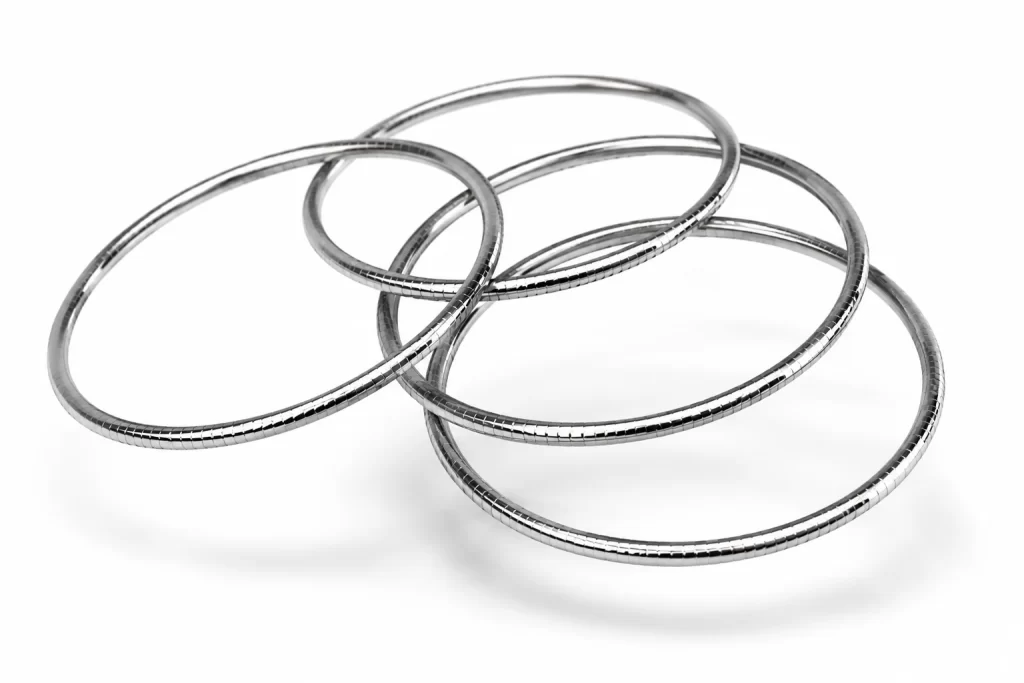
The Cryo-Ring™ a spring-energised, FEP/PFA-encapsulated cryogenic seal was developed specifically to address the failure modes that eliminate standard O-rings from cryogenic service. Its unique construction solves the two fundamental problems of elastomeric seals at low temperatures: loss of elasticity and cold flow.
How the Cryo-Ring™ Works
Unlike a conventional O-ring that relies entirely on the elastic recovery of the rubber compound, the Cryo-Ring™ uses a 302 stainless steel spiral-wound spring as its inner core. This spring provides consistent sealing force across the full operating temperature range from ambient down to -250°C. The spring is encapsulated in FEP or PFA, both chemically inert fluoropolymers that are compatible with virtually all cryogenic media including liquid oxygen, hydrogen, nitrogen, argon, LNG, and CO2.
| Cryo-Ring™ — Key Specifications at a Glance |
| Inner Core: 302 Stainless Steel spiral-wound spring |
| Encapsulation: FEP or PFA fluoropolymer |
| FEP Temperature Range: -250°C to +205°C (-418°F to +400°F) |
| PFA Temperature Range: -250°C to +260°C (-418°F to +500°F) |
| Industries: Industrial Gas, LNG, Hydrogen, Pharmaceutical, Food, Transportation |
| Sizes Available: Any cross-section and diameter; BS ISO 3601-1 / AS 568 standard sizes in stock |
| Venting: Ventilation holes available for applications above 100 bar to prevent encapsulation rupture |
| Advantage over solid PTFE: No cold flow stainless spring prevents dimensional loss under compression |
This construction means the Cryo-Ring™ can serve as a drop-in replacement for conventional O-rings in virtually any static sealing groove, while delivering reliable performance at temperatures that would cause standard seals to fail within hours or days of installation.
Cryo-Ring™ vs Standard O-Ring — Performance Comparison
| Property | Standard Elastomeric O-Ring | Cryo-Ring™ (FEP/PFA) |
| Min Operating Temperature | -60°C (Silicone) / -40°C (Viton) | -250°C |
| Material Flexibility at -200°C | Brittle — no elastic recovery | Spring-energised — maintains sealing force |
| Cold Flow Risk | Low (elastomers recover) | Eliminated — SS spring prevents deformation |
| LOX Compatibility | Not suitable (hydrocarbon elastomers) | Compatible (FEP/PFA fully inert) |
| LH2 Compatibility | Not suitable | Compatible (PFA grade) |
| Chemical Resistance | Media-dependent | Virtually universal (FEP/PFA chemically inert) |
| Shelf Life | Limited (elastomer ageing) | Unlimited (PTFE-family stability) |
| Custom Sizes | Standard sizes only | Any cross-section and diameter |
Selecting the Right Seal for Your Cryogenic System
Selecting the correct sealing solution for a cryogenic tank, pump, or valve connection requires evaluation across several factors. Getting this right at the specification stage avoids costly retrofits and unplanned maintenance shutdowns later.
Key Selection Criteria
- Operating temperature: Identify the minimum temperature the seal will experience in service consider both steady-state and transient (cold-down, warm-up) conditions.
- Media compatibility: Confirm the seal material is inert to the cryogenic fluid especially important for LOX and LH2 where incompatible materials create safety hazards.
- Pressure rating: Match seal geometry and spring force to system pressure. For applications above 100 bar, specify vented Cryo-Ring™ seals to prevent encapsulation rupture.
- Static vs dynamic: For static sealing (flanges, ports, valve bodies), Cryo-Ring™ is the preferred solution. For dynamic shaft seals, consult with an application engineer on appropriate mechanical seal face and secondary seal combinations.
- Groove dimensions: Cryo-Ring™ seals can be produced in any cross-section or diameter specify groove dimensions to receive correctly sized seals.
- Regulatory requirements: Confirm material certifications for regulated industries (food-grade, pharmaceutical, aerospace, oxygen service).
KAF Vulcan India provides Cryo-Ring™ seals in FEP and PFA grades, covering the full cryogenic temperature range with guaranteed stock for all BS ISO 3601-1 and AS 568 standard sizes and short lead times on custom dimensions.
Industry Applications at a Glance
Cryogenic storage tanks, pumps, and valves — and the sealing solutions that protect them — serve a wide range of industries:
| Industry | Cryogenic Equipment Used | Critical Seal Locations |
| Industrial Gas Production & Distribution | Bulk storage tanks, transport tankers, microbulk units, vaporisers | Nozzle flanges, pressure relief valves, instrument ports |
| LNG (Liquefied Natural Gas) | LNG storage tanks, loading arms, regasification systems | Ball valve stem seals, flange O-rings, PRV seats |
| Liquid Hydrogen (Clean Energy) | LH2 storage, fuelling stations, transport vessels | All static seals — PFA grade required for -253°C |
| Aerospace & Space Launch | Propellant tanks (LOX, LH2), ground support equipment | Valve seats, fill/drain connections, vent line seals |
| Healthcare & Life Sciences | LN2 supply systems, cryo-bio containers, MRI cooling | Sterile, inert seals at fill ports and instrument connections |
| Pharmaceuticals | LN2 storage, cryogenic processing equipment | Leak-tight, hygienic sealing at every process connection |
| Food & Beverage | LN2 quick-freezing, carbonation (LCO2) systems | Food-grade FEP/PFA seals at all fluid-contact points |
| Electronics Manufacturing | LN2 cooling systems, precision temperature control | Ultra-clean, particle-free sealing |
Protecting Cryogenic Systems Starts with the Right Seal
Every cryogenic system whether a bulk storage tank at an industrial gas facility, a pump skid at an LNG terminal, or a valve manifold at a space launch facility depends on precision sealing to operate safely and reliably. The extreme temperatures involved eliminate standard elastomeric O-rings from consideration and require purpose-engineered cryogenic sealing solutions.
The Cryo-Ring™ spring-energised seal, available from KAF Vulcan India, provides the widest temperature range of any encapsulated O-ring sealing product, with full compatibility with all major cryogenic media including liquid oxygen and liquid hydrogen. Its stainless steel spring core eliminates cold flow the single biggest failure mode in cryogenic static sealing while the FEP/PFA encapsulation delivers the chemical inertness required for safe, long-life operation.
Whether you are specifying seals for a new cryogenic system, solving a chronic leak problem on an existing installation, or upgrading from standard O-rings to a cryogenic-rated alternative, KAF Vulcan India has the technical expertise and product availability to support you.