
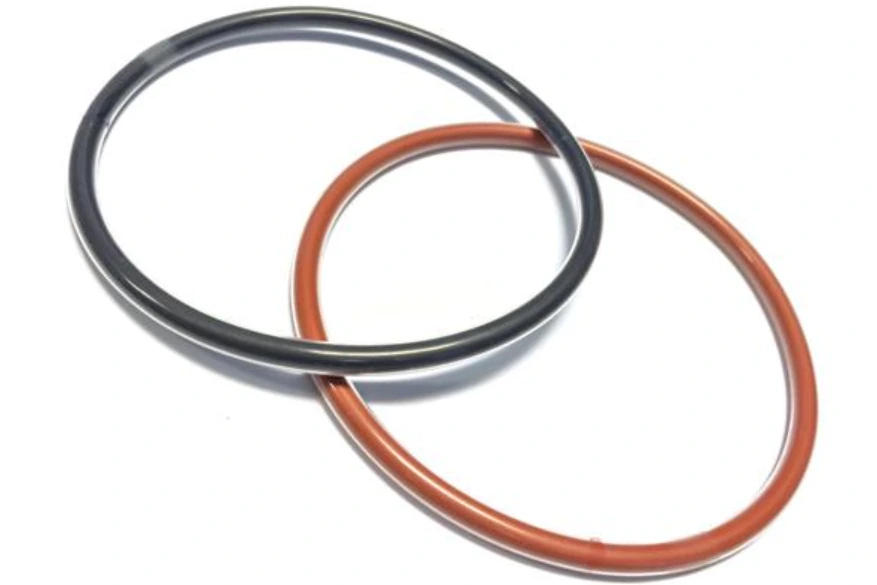
In industrial sealing applications, selecting the correct O-ring material is often the difference between long-term reliability and frequent leakage failures. While standard elastomer O-rings such as NBR, EPDM, Silicone, or FKM work well in general conditions, they tend to fail when exposed to aggressive chemicals, high temperatures, or strict regulatory environments.
This is where encapsulated and coated O-rings become important. Although these two terms are sometimes used interchangeably, they refer to two completely different technologies.
Understanding their construction, working principle, and ideal applications helps engineers and procurement teams choose the right sealing solution.
Understanding Encapsulated O-Rings
An encapsulated O-ring is a composite sealing element made of two parts:
- A flexible elastomer core (usually Silicone or FKM/Viton)
- A seamless fluoropolymer outer jacket made of FEP or PFA
The outer fluoropolymer layer provides exceptional chemical resistance, while the inner elastomer core ensures elasticity and compression recovery.
In simple terms, an encapsulated O-ring combines the chemical stability of PTFE with the flexibility of rubber.
How Encapsulated O-Rings Function
The PTFE-based outer jacket acts as a protective barrier. It prevents aggressive media such as acids, solvents, fuels, and corrosive chemicals from attacking the elastomer core.
At the same time, the elastomer core inside maintains sealing force. When compressed inside a groove, the O-ring deforms slightly and creates contact pressure against the mating surfaces.
When internal system pressure increases, the seal distributes the load evenly across the sealing interface. This is why encapsulated O-rings are highly effective in static sealing environments.
Because the fluoropolymer layer is chemically inert, it does not react with most industrial fluids. This makes encapsulated O-rings suitable for pharmaceutical, chemical processing, and food-grade applications.
Construction Variations of Encapsulated O-Rings
Encapsulated O-rings are typically manufactured in two core designs.
The first is the solid core version. This design provides stronger compression and is generally used in fully static applications such as pipe flanges, reactor vessels, manways, and inspection covers.
The second is the hollow silicone core version. This version is designed for lower compression force applications. It is suitable for semi-static or lightly dynamic conditions where lower installation force is required.
FEP vs PFA Encapsulation – Technical Comparison
Both FEP and PFA belong to the fluoropolymer family. However, their temperature resistance and performance characteristics differ slightly.
| Property | FEP Encapsulation | PFA Encapsulation |
| Maximum Continuous Temperature | Approx. 205°C | Approx. 260°C |
| Chemical Resistance | Excellent | Superior |
| Flexibility | Good | Slightly lower |
| Cost | Moderate | Higher |
| Preferred Applications | General chemical handling | High temperature and aggressive chemicals |
If the application involves temperatures above 200°C or highly aggressive solvents, PFA is usually recommended. For standard chemical environments below 200°C, FEP is often sufficient and more economical.
Advantages of Encapsulated O-Rings
Encapsulated O-rings offer several advantages over standard elastomer seals. Their resistance to corrosive fluids significantly extends service life in chemical plants. They are also compliant with FDA and USP Class VI standards when manufactured with approved materials, making them suitable for pharmaceutical and food processing equipment.
Because the outer layer is chemically inert, contamination risk is minimized. In industries such as semiconductor manufacturing, where purity is critical, encapsulated O-rings are widely used.
They are also manufactured according to international dimensional standards such as ISO 3601, BS, and AS568, ensuring compatibility with standard grooves.
Limitations of Encapsulated O-Rings
While highly resistant to chemicals, encapsulated O-rings are not ideal for heavy dynamic applications. The outer fluoropolymer layer is less elastic than pure rubber and may experience fatigue under continuous motion.
Installation must also be done carefully to avoid damaging the outer sheath. Sharp groove edges can cut the jacket and compromise performance.
Therefore, they are best suited for static or low-movement sealing systems.
What Are Coated O-Rings?
Coated O-rings are different from encapsulated O-rings. Instead of having a full fluoropolymer tube around the elastomer core, coated O-rings have a thin PTFE layer applied directly onto the rubber surface.
This coating adheres to the elastomer body rather than forming a separate protective shell.
The purpose of coating is not primarily chemical resistance. Instead, it is to reduce friction and improve assembly performance.
Why PTFE Coated O-Rings Are Used
In automated assembly lines or systems where seals must slide into place, friction can create problems. O-rings may twist, tear, or stick during installation.
A PTFE coating provides a low-friction surface that improves handling and installation. It also reduces break-in torque in rotating components and prevents sticking after long storage.
Color coatings are often used for identification during assembly, reducing installation errors in production environments.
Encapsulated vs Coated O-Rings – Engineering Comparison
| Parameter | Encapsulated O-Rings | Coated O-Rings |
| Structure | Elastomer core inside PTFE/FEP/PFA tube | Elastomer with thin PTFE surface coating |
| Chemical Protection | Very High | Limited |
| Temperature Capability | Up to 260°C | Depends on base elastomer |
| Friction Reduction | Moderate | Excellent |
| Dynamic Applications | Limited | Better suited |
| Typical Industries | Chemical, Pharma, Semiconductor | Automotive, Assembly Lines, General Industry |
| Cost Level | Higher | Lower |
Industrial Applications of Encapsulated O-Rings
Encapsulated O-rings are widely used in:
- Chemical processing plants where acids and solvents are present.
- Pharmaceutical production equipment requiring FDA compliance.
- Food processing systems that demand hygienic sealing.
- Semiconductor manufacturing environments where contamination must be avoided.
- Oil and gas installations exposed to aggressive hydrocarbons.
- Water treatment facilities handling chlorinated media.
- These industries require reliability under extreme conditions where standard rubber seals degrade quickly.
When to Select Encapsulated O-Rings
Encapsulated O-rings should be selected when:
- The sealing media is chemically aggressive.
- The operating temperature exceeds normal elastomer limits.
- Compliance standards such as FDA or USP are required.
- Long service life is critical in static applications.
- Leakage risk must be minimized in high-value systems.
When to Select Coated O-Rings
Coated O-rings are suitable when:
- Friction reduction is the primary requirement.
- Installation ease is important.
- Components must not stick after long storage.
- Automated assembly lines require smooth handling.
- The application does not involve highly aggressive chemicals.
Installation Considerations
Encapsulated O-rings require smooth groove finishes and proper installation techniques. Sharp edges must be removed. Excessive stretching should be avoided.
Coated O-rings require inspection of the coating surface before installation. Damaged coatings can reduce performance.
Correct groove dimensions according to ISO standards should always be followed for both types.
Dimensional Standards
Encapsulated O-rings follow the same dimensional standards as standard elastomer O-rings:
| Standard | Region |
| ISO 3601 | International |
| BS Standards | United Kingdom |
| AS568 | United States |
The encapsulation process does not increase the cross-sectional dimension, ensuring compatibility with existing hardware.
Final Conclusion
Encapsulated and coated O-rings and seals serve different purposes in industrial sealing systems. Encapsulated O-rings and seals are designed for chemical resistance and high-temperature static sealing, making them suitable for aggressive environments. Coated O-rings and seals are engineered to reduce friction, improve installation efficiency, and support smoother assembly. Choosing between these O-rings and seals depends on operating conditions, chemical exposure, temperature, compliance requirements, and movement within the sealing system. Selecting the right O-rings and seals improves equipment reliability, reduces downtime, and lowers maintenance costs.