
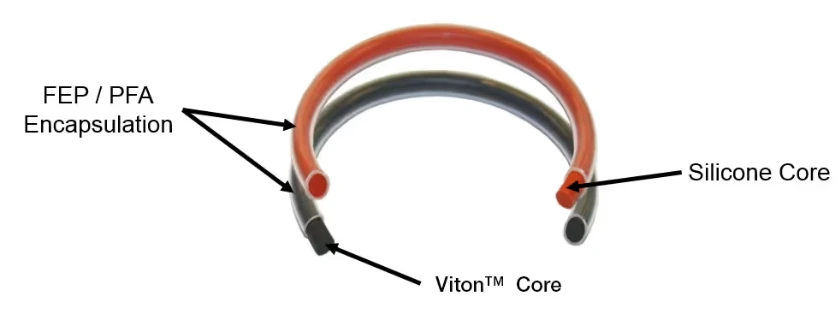
In industries where performance, safety, and efficiency cannot be compromised, sealing solutions play a critical role. Among the wide array of sealing options, encapsulated O-rings are preferred for their ability to withstand conditions too harsh for standard elastomer seals. These O-rings have an elastomer core for flexibility and a polymer jacket that resists chemicals and heat. This unique construction enables them to perform reliably in extreme environments, but understanding their advantages and disadvantages is essential for selecting the right seal.
What Is Encapsulated O-Rings?
Encapsulated O-rings are designed to blend the flexibility of elastomers with the chemical and thermal durability of advanced polymers. The inner core, typically composed of silicone or Viton, offers flexibility to ensure effective compression and sealing. The outer jacket, made of PTFE or FEP, forms a protective layer that shields the core from aggressive chemicals, surface wear, and extreme temperatures.
PTFE encapsulated O rings and Teflon encapsulated O rings are frequently used interchangeably, since PTFE is the polymer used in the Teflon brand. For specialized needs, manufacturers create Teflon-encapsulated Viton O rings that provide chemical inertness and durability. They also produce Teflon-encapsulated silicone O rings, which blend flexibility with a strong protective layer. By selecting the right combination of core and jacket, industries can achieve seals that perform where conventional elastomer O-rings would fail.
Advantages of Encapsulated O-Rings
- One of the most significant benefits of encapsulated O-rings is their chemical resistance. The PTFE or FEP jacket is chemically inert, allowing the O-ring to withstand acids, alkalis, fuels, and other aggressive substances without degradation. This makes them highly suitable for industries where exposure to chemicals is unavoidable.
- Encapsulated O-rings also excel under extreme temperature conditions. Their polymer jacket maintains integrity in both cryogenic environments and high-heat applications, ensuring reliable sealing even when conventional elastomers degrade. The smooth, low-friction surface reduces wear and facilitates easier installation compared to rougher elastomeric seals, contributing to extended service life and reduced maintenance costs.
- In sensitive industries such as food processing and pharmaceuticals, encapsulated O-rings offer hygienic, non-stick properties, preventing contamination and ensuring compliance with safety standards. Variants like PTFE encapsulated Viton O rings provide a balance of flexibility and resistance. Conversely, FEP-encapsulated gaskets are perfect for pipelines and processing equipment, especially where chemical safety and reliable operation are crucial.
Disadvantages of Encapsulated O-Rings
- Despite their advantages, encapsulated O-rings are not ideal for every application. Their primary limitation is reduced flexibility compared to standard elastomer O-rings. The outer polymer layer limits the elastomer core’s natural stretching and rebounds, reducing its suitability for highly dynamic applications involving continuous movement or flexing.
- Cost is another factor to consider. Encapsulated O-rings tend to be pricier than standard options because of their specialized materials and manufacturing process. Installation requires careful handling, as damage to the polymer jacket can compromise sealing performance. Furthermore, in low-demand applications, a traditional elastomer O-ring may provide adequate sealing at a significantly lower cost. For instance, while Teflon-encapsulated O-rings offer superior durability, they may not be the most economical choice for simple, general-purpose sealing tasks.
Applications Across Industries
Encapsulated O-rings are widely used in industries where consistent sealing performance under harsh conditions is critical:
- Food and Beverage: Provide hygienic sealing against oils, fats, and cleaning chemicals while meeting safety standards.
- Pharmaceuticals: Chemically inert surfaces ensure sterile sealing during the manufacturing of medicines and medical devices.
- Chemical Processing: Resistant to highly corrosive fluids and gases, making them ideal for reactors, mixers, and pipelines.
- Oil and Gas: Perform reliably in environments with extreme pressures and high temperatures.
- Industrial Connections: FEP encapsulated camlock gaskets offer secure, leak-free connections in chemical transfer systems, preventing contamination and ensuring safety.
Special Types and Variants
The versatility of encapsulated O-rings is reflected in their wide range of variants. PTFE encapsulated O-rings are prized for chemical compatibility and thermal stability, while Teflon encapsulated O-rings are preferred in corrosive environments. For specialized requirements, Teflon encapsulated Viton O rings combine Viton’s durability with Teflon’s inert barrier, and Teflon encapsulated silicone O rings are chosen when flexibility is essential, such as in frequent compression applications.
FEP-based solutions, such as FEP-encapsulated gaskets and FEP-encapsulated camlock gaskets, offer dependable sealing for static joints and quick-connect couplings in industries that prioritize chemical resistance and operational efficiency. These variations ensure that encapsulated O-rings can meet the demands of a diverse range of industrial challenges.
Making the Right Choice
Selecting the appropriate sealing solution depends on operational requirements, chemical exposure, temperature ranges, and industry standards. Encapsulated O-rings are ideal for applications involving harsh chemicals, extreme temperature fluctuations, or hygiene-sensitive processes. For simpler or less demanding environments, conventional elastomer O-rings may be more cost-effective without compromising performance. By taking these factors into account, industries can choose the most appropriate sealing solution with confidence.
Precision Sealing with KAF-Vulcan India
Encapsulated O-rings continue to be a dependable option where safety and reliability are essential. Their ability to resist chemicals, operate under extreme temperatures, and maintain hygienic properties offers a clear advantage over traditional seals. While they require careful handling and incur higher costs, the long-term benefits often outweigh these drawbacks, particularly in critical industrial applications.
At KAF-Vulcan India, we offer advanced sealing solutions tailored to diverse industrial needs. Our product range includes PTFE encapsulated O rings, Teflon encapsulated Viton O rings, and FEP encapsulated gaskets, all designed for consistent, high-performance operation. Whether you require FEP encapsulated camlock gaskets for chemical transfer lines or Teflon encapsulated silicone O rings for food-grade applications, our solutions deliver precision, durability, and reliability. Connect with our team today to explore how KAF-VulcanIndia can support your sealing requirements.