
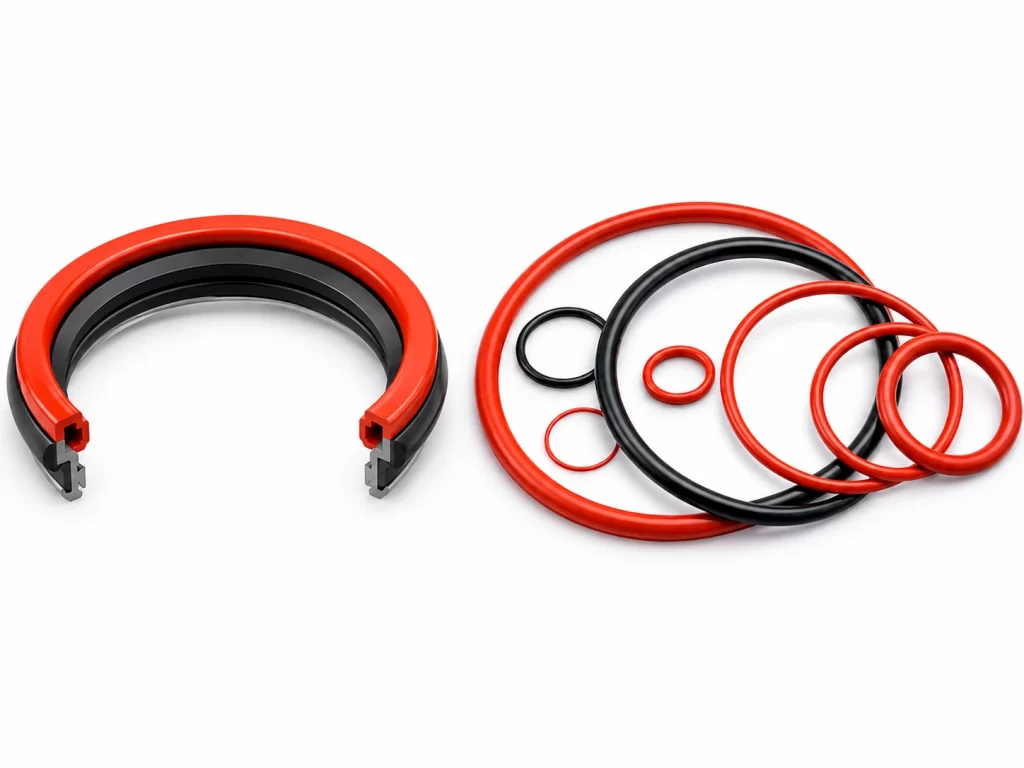
Industrial sealing applications often involve heat, chemicals, pressure, or demanding cleaning conditions. A standard elastomer O-ring may not always provide the material resistance needed for such environments. This is where an encapsulated O-ring can be considered.
Teflon encapsulated Viton Orings combine a Viton/FKM elastomer core with a thin fluoropolymer outer layer. The core provides the sealing force, while the outer layer provides a barrier against the process media.
Teflon encapsulated Orings are useful when both chemical resistance and elastic recovery are important. However, the correct choice depends on temperature, media, pressure, movement, and gland design.
KAF Vulcan provides encapsulated sealing solutions for industrial applications where material selection and operating conditions need careful consideration.
What Is a Teflon Encapsulated Viton O-Ring?
A Teflon encapsulated Viton O-ring has two main parts:
- A Viton/FKM elastomer core
- A fluoropolymer outer encapsulation
The Viton/FKM core helps the O-ring maintain contact with the sealing surfaces. The fluoropolymer layer protects the core from direct exposure to the process media.
The term “Teflon” is commonly used in the industry for PTFE-based materials. For technical selection, the exact encapsulation material should always be confirmed with the supplier.
Teflon encapsulated Orings are available in different constructions and sizes. The choice should be based on the actual application rather than the name of the material alone.
When Does This O-Ring Make Sense?
This sealing design is useful when a standard elastomer O-ring may face material compatibility limits.
It can be considered for applications involving:
- Aggressive process chemicals
- Solvents and cleaning fluids
- Food and pharmaceutical equipment
- Chemical processing systems
- Semiconductor equipment
- Process pumps and valves
- Static flange and cover seals
- Equipment exposed to demanding cleaning cycles
A fluoropolymer jacket can provide a chemically resistant sealing surface. At the same time, the elastomer core helps provide the flexibility needed for sealing.
However, no O-ring material should be treated as suitable for every chemical. The actual media, concentration, temperature, exposure time, and pressure should be reviewed before selection.
How Does the Viton Core Support Sealing?
The core has an important role in overall design.
A solid Viton/FKM core provides the elastic force needed to keep the seal against the gland surfaces. This is particularly useful in static sealing applications where the O-ring must maintain contact over time.
The core can also help the seal accommodate small changes in the sealing surfaces.
By comparison, a fully solid fluoropolymer ring may not provide the same type of elastic recovery as an elastomer-supported design.
This makes Teflon encapsulated Viton Orings useful when the application needs a balance between chemical resistance and sealing force.
What Makes the Encapsulation Important?
The outer layer is the part that comes into contact with the process environment. Its condition is therefore important to sealing performance.
Key considerations include:
| Application Factor | Why It Matters |
| Process media | Determines material compatibility |
| Temperature | Affects both core and encapsulation |
| Pressure | Influences seal loading and extrusion risk |
| Movement | Determines whether the seal suits static or dynamic service |
| Gland design | Controls squeeze and seal positioning |
| Installation | Prevents cuts or damage to the encapsulation |
The outer layer should remain intact during installation. Sharp gland edges, incorrect stretching, or excessive force can damage it.
How Do They Compare with Silicone O-Rings?
A silicone Oring is often selected when flexibility and temperature characteristics suit the application. Silicone can also be useful in certain food, pharmaceutical, and clean-processing environments when the required specification is met.
However, silicone and fluoropolymer-encapsulated designs solve different sealing challenges.
A silicone Oring may be suitable where a flexible elastomer seal is required, and the process media is compatible with silicone.
A fluoropolymer-encapsulated design may be considered when the sealing surface needs greater resistance to certain aggressive media.
The decision should therefore be based on the complete application rather than choosing one material as a general replacement for another.
Where Are Teflon Encapsulated O-Rings Commonly Used?
Teflon encapsulated Orings can be used across several industrial sectors.
Common areas include:
Chemical Processing
Chemical equipment can expose seals to solvents, acids, alkalis, and other process media. Material compatibility is a key part of seal selection.
Pharmaceutical And Food Processing
Clean processing equipment may require sealing materials that meet specific regulatory or hygiene requirements. The exact compliance specification should be confirmed for the selected product.
Semiconductor Manufacturing
Process equipment can involve chemicals and controlled environments. Seal construction and surface condition can be important considerations.
Pumps And Valves
Static seals in pumps, valves, covers, and flanges may benefit from an encapsulated design when the process media requires a suitable fluoropolymer barrier.
When Should You Choose A Different Seal?
An encapsulated O-ring is not automatically the right option for every application.
A different seal design may be more suitable when:
- The application involves high-speed dynamic movement
- The gland does not provide enough room for the selected O-ring
- The pressure creates a significant extrusion risk
- The operating temperature exceeds the material limits
- The encapsulation could be damaged during installation
- The required elastic recovery is not suitable for the selected construction
In some applications, a tadpole gasket rope may be considered instead. This type of sealing solution can suit certain large, irregular, or specialized sealing arrangements.
A tadpole seal may also be used where the application requires a flexible seal profile rather than a conventional O-ring.
The final choice should always consider the equipment design and service conditions.
What Should Engineers Check Before Selection?
Before ordering Teflon encapsulated Viton Orings, engineers should review the complete operating environment.
Important questions include:
- What fluid or gas will contact the seal?
- What is the normal and maximum temperature?
- Is the seal static or dynamic?
- What pressure will it experience?
- What is the gland size and geometry?
- What level of O-ring squeeze is required?
- Could the seal face sharp edges during installation?
- Are there specific compliance requirements?
These details help reduce the risk of selecting a seal based only on material names.
Select The Seal Around The Application
The right O-ring should match the process conditions, not simply the equipment type. Teflon encapsulated Viton Orings can be a practical option when a Viton/FKM core and fluoropolymer sealing surface are both useful for the application.
Teflon encapsulated Orings should be selected after reviewing media compatibility, temperature, pressure, movement, gland design, and installation conditions.
A silicone Oring may be more appropriate for applications where silicone’s properties match the operating environment. In other cases, a tadpole gasket rope or tadpole seal may provide a better fit for the sealing geometry.
KAF Vulcan provides industrial sealing solutions with a focus on application-specific selection. They can help technical teams review suitable encapsulated O-ring options based on operating conditions and equipment requirements. For a specific application, contact KAF Vulcan to discuss the sealing requirement or request a quote.