
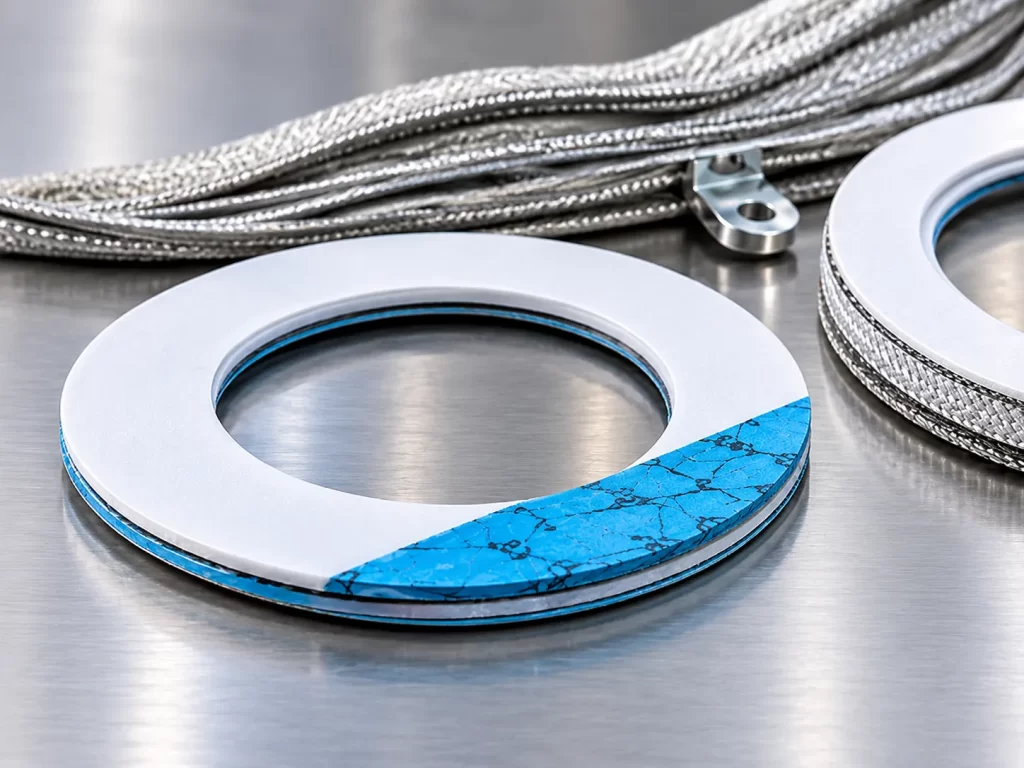
Gaskets are used to control leakage between two joined surfaces. But standard gasket materials may not suit every process. Chemical exposure, temperature, pressure, and cleanliness requirements can make material selection more difficult.
PTFE envelope gaskets use a PTFE outer layer around an internal core or insert. The PTFE provides the process-contact surface, while the internal material helps support the gasket and maintain sealing contact.
For plant maintenance and engineering teams, understanding how do PTFE envelope gaskets work can make gasket selection easier. The right choice still depends on the equipment, media, temperature, pressure, and joint design.
Kaf Vulcan provides engineered sealing solutions for industrial applications. Their range includes PTFE-based sealing products designed for different operating requirements.
What Are PTFE Envelope Gaskets?
PTFE envelope gaskets are composite sealing elements made from a PTFE envelope and an internal insert. The outer PTFE layer is designed to contact the process media.
The insert provides structural support and helps the gasket maintain contact between the mating surfaces.
This construction brings together two different functions:
- The PTFE layer provides the main process-contact barrier
- The core supports the gasket mechanically
- The gasket is compressed between the mating surfaces
- The PTFE layer conforms to suitable surface irregularities
Kaf Vulcan’s PTFE envelope gasket range includes virgin PTFE, modified PTFE, and antistatic or conductive PTFE options for specific applications.
How Do PTFE Envelope Gaskets Work?
The basic principle behind how do PTFE envelope gaskets work is controlled compression.
When the gasket is placed between two mating surfaces, the joint is tightened. This compresses the gasket and creates contact across the sealing area.
The PTFE envelope forms the outer sealing surface. The internal insert provides additional support and resilience.
The result depends on several factors:
- Correct gasket dimensions
- Suitable compression
- Proper flange condition
- Appropriate PTFE grade
- Correct core material
- Suitable operating conditions
The gasket should be selected according to the joint rather than treated as a one-size-fits-all component.
What Are the Key PTFE Envelope Gaskets Features?
The main PTFE Envelope Gaskets features come from the combination of the PTFE jacket and the internal core.
Important features can include:
| Feature | Purpose |
| PTFE outer layer | Provides the process-contact surface |
| Internal insert | Supports the gasket structure |
| Chemical resistance | Helps suit selected process media |
| Low-friction surface | Supports handling and installation |
| Different PTFE grades | Allows selection for specific requirements |
| Custom sizes | Helps match different flange arrangements |
The exact PTFE Envelope Gaskets features depend on the selected construction and material grade.
For critical applications, the product specification should be checked against the actual process conditions.
Why Is PTFE Used for Industrial Gaskets?
PTFE is widely considered for applications where chemical resistance is important. It also has a low-friction surface and can be used across a range of industrial sealing conditions.
This makes PTFE-based products useful in selected chemical, pharmaceutical, food, semiconductor, and process applications.
However, material selection should not be based on chemical resistance alone.
Temperature, pressure, flange design, compression, and mechanical loading also affect the suitability of the gasket.
For this reason, PTFE sealing rings and envelope gaskets should be selected according to the complete operating environment.
What Is the Role of PTFE Sealing Rings?
PTFE sealing rings are used in applications where a PTFE sealing surface is required in a ring-shaped configuration.
Their design can differ from an envelope gasket. The correct choice depends on the joint, equipment design, dimensions, and required sealing method.
For some applications, PTFE sealing rings may provide a suitable solution for static sealing. In other cases, an envelope construction can provide a better combination of a PTFE contact surface and an internal supporting material.
Engineers should therefore compare the sealing geometry as well as the material.
What Industries Use PTFE Envelope Gaskets?
A common question from buyers is what industries use PTFE envelope gaskets?
They can be considered in industries where process media and operating conditions require a suitable PTFE-based sealing solution.
Typical applications include:
- Chemical processing
- Pharmaceutical manufacturing
- Food and beverage processing
- Semiconductor production
- Water treatment
- Petrochemical processing
- Industrial process equipment
- Tank and vessel connections
The question of what industries use PTFE envelope gaskets should always be followed by a review of the specific application.
Two plants in the same industry can have very different temperature, pressure, and media conditions.
How Should You Choose the Right PTFE Grade?
Not all PTFE grades have identical properties.
Kaf Vulcan’s product range includes different PTFE options for different service requirements. Virgin PTFE may be considered for suitable general applications, while modified or antistatic grades may be selected where their specific properties are required.
When selecting PTFE envelope gaskets, engineers should review:
- Process fluid or media
- Operating temperature
- Operating pressure
- Flange dimensions
- Surface condition
- Required electrical properties
- Core material
- Applicable compliance requirements
Any food, pharmaceutical, or other industry-specific compliance claim should be confirmed for the exact product specification.
What Installation Practices Help Maintain Sealing Performance?
A good gasket can still perform poorly if it is installed incorrectly.
Before fitting PTFE sealing rings or envelope gaskets, the mating surfaces should be cleaned and inspected. Dirt, scratches, or damage can affect the sealing area.
The gasket should be positioned correctly. Bolting should provide even compression across the joint.
Maintenance teams should also avoid excessive tightening. Too much compression can damage the gasket or affect the joint.
After installation, the connection should be monitored during start-up and operation.
These basic steps support more consistent sealing performance and can help reduce avoidable installation-related problems.
When Should PTFE Envelope Gaskets Be Considered?
PTFE envelope gaskets can be useful when the application needs a PTFE process-contact surface combined with an internal supporting core.
They may be considered when:
- Chemical exposure is a key concern
- A low-friction sealing surface is useful
- The joint requires a composite gasket construction
- Different core materials may be needed
- The application has specific sealing dimensions
The final selection should be based on actual operating conditions. A PTFE-based gasket is not automatically suitable simply because the process involves chemicals.
Choose The Gasket Based on The Application
Understanding how do PTFE envelope gaskets work helps engineers look beyond the material name. The PTFE envelope provides the main process-contact surface, while the core supports the gasket within the joint.
The right solution depends on the gasket design, PTFE grade, core material, dimensions, compression, temperature, pressure, and process media. The same approach applies when comparing PTFE sealing rings with other sealing configurations.
Kaf Vulcan provides engineered sealing products for industrial applications. They offer different PTFE envelope constructions and related sealing solutions based on application requirements. Their technical approach helps customers review product specifications before selecting a gasket.
For teams evaluating PTFE envelope gaskets, they can discuss the operating conditions, product requirements, and suitable configuration. Contact Kaf Vulcan to discuss an application or request a quotation.