
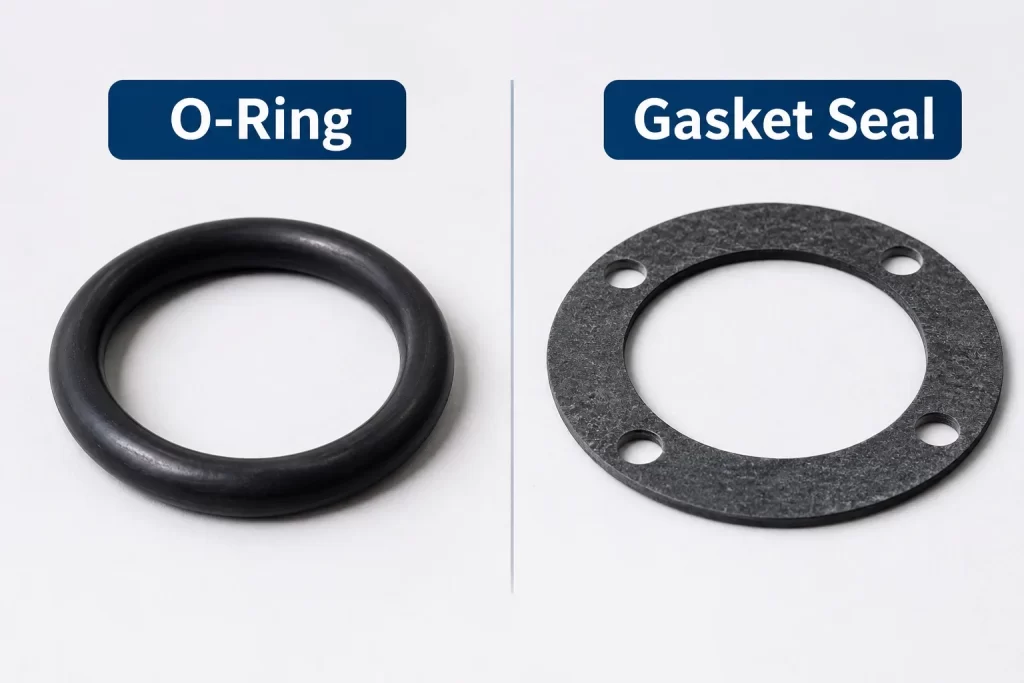
When replacing or specifying a seal, one of the most common questions is whether to use an O-ring or a gasket. Although both prevent the leakage of liquids or gases, they are fundamentally different in design, working mechanism, and ideal application.
Choosing the wrong type can result in leakage, premature failure, or unnecessary maintenance costs. Understanding how each seal works under pressure, temperature, and movement is essential before making a decision.
What Is an O-Ring?
An O-ring is a circular elastomeric seal with a round cross-section. It is designed to sit inside a precision-engineered groove (also called a gland) between two mating components.
When the parts are assembled, the O-ring compresses. This compression creates contact stress against the surfaces. When internal system pressure increases, it pushes the O-ring toward the low-pressure side of the groove, increasing sealing force.
This pressure-assisted sealing behavior is why O-rings perform exceptionally well in high-pressure systems.
O-rings are commonly used in:
- Hydraulic cylinders
- Pneumatic systems
- Pumps and valves
- Automotive fuel systems
- Industrial machinery
They can function in both static (no movement) and dynamic (movement between parts) applications, provided the correct material and groove design are used.
What Is a Gasket?
A gasket is typically a flat sealing element placed between two flat mating surfaces. Unlike O-rings, gaskets are not restricted to circular shapes. They can be cut or manufactured in almost any geometry required.
Gaskets create a seal by surface compression across a larger area. When bolted between flanges or housings, they fill surface imperfections and prevent leakage.
They are often manufactured from:
- Rubber sheets (Nitrile, EPDM, Silicone)
- Graphite
- Metal
- Composite or layered materials
Because they cover broader surface areas, gaskets are well suited for flange connections and irregular geometries.
Core Differences Between O-Rings and Gaskets
The difference becomes clearer when comparing their working principles and design characteristics.
| Feature | O-Ring | Gasket |
| Shape | Circular (torus) | Flat, custom shapes |
| Installation | Fits in groove | Clamped between flat surfaces |
| Pressure Behavior | Sealing force increases with pressure | Sealing efficiency may decrease under very high pressure |
| Best For | Cylindrical joints, high-pressure systems | Flat flanges, large sealing areas |
| Movement | Static and dynamic | Primarily static |
| Space Requirement | Compact | Requires wider surface area |
| Customization | Standard sizes widely available | Often custom cut |
Performance Under Pressure
One of the most important technical differences lies in how each seal reacts to pressure.
An O-ring is pressure-energized. As internal pressure rises, the O-ring deforms further into the groove, increasing its sealing contact force. This makes it highly reliable in hydraulic and pneumatic systems.
A gasket, however, relies on bolt compression. Excessive internal pressure can reduce gasket compression or cause blowout if not properly designed. For extremely high-pressure applications, O-rings are generally superior.
Performance Under Temperature
Temperature performance depends largely on material selection for both seals.
Gaskets often have an advantage in extreme temperature ranges because metal, graphite, and composite gaskets can tolerate conditions beyond what most elastomers can withstand.
O-rings perform very well within their material temperature range, but if exposed beyond their rating, they can harden, crack, or lose elasticity.
Material choice is more critical than seal type in high-temperature environments.
Geometry and Design Constraints
The geometry of the sealing interface often determines which solution is viable.
If the joint is circular and allows for groove machining, an O-ring is typically the more efficient and compact solution.
If the joint is flat, irregular, rectangular, or large, designing an O-ring groove may not be practical. In those cases, a gasket becomes the natural choice.
Cost and Maintenance Considerations
O-rings are generally more economical for small sealing applications. Standard sizes are widely available and easy to replace.
Gaskets may be more expensive when custom shapes are required, but they are often necessary for flange sealing and large surface areas.
Maintenance complexity is also different. O-rings require correct groove design but are easier to install. Gaskets require proper bolt torque and alignment to ensure even compression.
Which Seal Should You Choose?
The decision between an O-ring and a gasket should be based on:
- Surface geometry
- Pressure level
- Temperature range
- Chemical compatibility
- Movement (static or dynamic)
- Available installation space
If your system operates under high pressure and uses cylindrical mating parts, an O-ring is usually the better engineering choice.
If your system involves flat flanges, irregular shapes, or very large sealing areas, a gasket will likely perform better.
Neither seal is universally superior. The correct choice depends entirely on application conditions.
Final Thought
Although O-rings and gaskets both prevent leakage, they are not interchangeable. Their working mechanisms, installation requirements, and pressure behaviors are fundamentally different.
An O-ring excels in compact, pressure-driven cylindrical applications. A gasket performs better across flat surfaces and complex geometries.
The most reliable sealing systems are designed by evaluating the full operating environment—pressure, temperature, chemical exposure, movement, and space constraints—before selecting the seal type.
When these factors are properly assessed, both O-rings and gaskets can deliver long-term, dependable sealing performance within any O rings and seal application.