
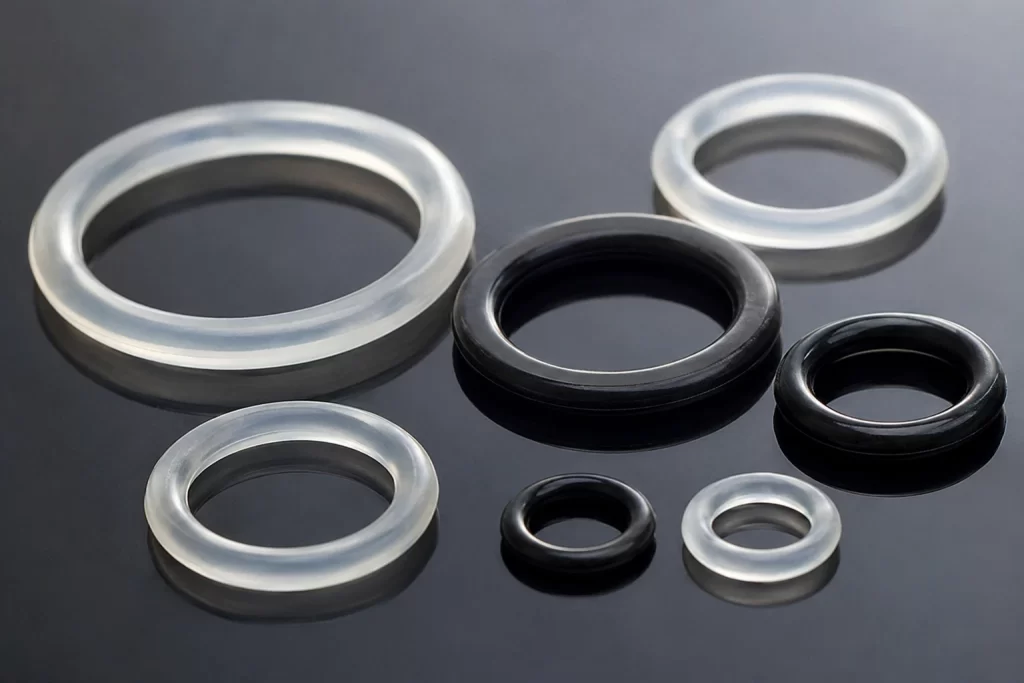
Encapsulated O-rings are widely used in industries where traditional elastomer seals struggle to survive. When exposed to aggressive chemicals, extreme temperatures, or strict hygiene regulations, standard rubber O-rings often fail due to swelling, degradation, or loss of elasticity.
Encapsulated O-rings were developed to overcome these challenges. They combine two materials into one engineered sealing solution. The result is a seal that delivers chemical resistance along with mechanical resilience.
However, like any engineered product, encapsulated O-rings offer advantages as well as limitations. Understanding both sides helps engineers make better sealing decisions.
What Makes Encapsulated O-Rings Different?
An encapsulated O-ring consists of:
- A flexible elastomer core (typically Silicone or FKM/Viton)
- A seamless fluoropolymer jacket (FEP or PFA)
The outer jacket provides chemical resistance. The inner core maintains elasticity and compression force.
This dual-material construction makes encapsulated O-rings fundamentally different from standard rubber O-rings.
The performance of the seal is influenced by both materials. Therefore, the working limits are determined by the weaker component of the two.
Key Benefits of Encapsulated O-Rings
- Superior Chemical Resistance
The fluoropolymer outer layer, typically FEP or PFA, is highly resistant to:
- Strong acids
- Alkalis
- Solvents
- Hydrocarbons
- Cleaning chemicals
In chemical processing plants and pharmaceutical manufacturing, this resistance significantly increases service life compared to standard elastomers.
The PTFE-based sheath acts as a protective barrier that isolates the elastomer core from aggressive media.
- Wide Temperature Capability
Encapsulated O-rings perform well across a broad temperature range. However, the exact range depends on the combination of core and jacket materials.
| Encapsulation Type | Maximum Continuous Temperature |
| FEP | Approx. 205°C |
| PFA | Approx. 260°C |
Low-temperature performance depends on the elastomer core material.
It is important to remember that temperature performance is limited by whichever material reaches its limit first — either the core or the jacket.
- Compliance for Regulated Industries
Encapsulated O-rings are often manufactured using FDA-compliant materials. USP Class VI grades are also available.
This makes them suitable for:
- Pharmaceutical processing
- Food and beverage production
- Biotechnology equipment
- High-purity semiconductor applications
The fluoropolymer surface reduces contamination risk, which is critical in hygienic systems.
- Reduced Permeation and Swelling
Traditional rubber O-rings can absorb chemicals, leading to swelling and softening. Encapsulated O-rings significantly reduce permeation because the outer sheath resists fluid penetration.
This leads to:
- Dimensional stability
- Improved sealing consistency
- Longer maintenance intervals
- Improved Service Life in Static Applications
Encapsulated O-rings perform exceptionally well in static sealing environments such as:
- Pipe flanges
- Tank lids
- Manways
- Valve bodies
- Reactor vessels
Because there is minimal movement, the fluoropolymer sheath remains intact for long periods.
Limitations of Encapsulated O-Rings
While highly resistant to chemicals, encapsulated O-rings are not suitable for every application.
Understanding their limitations prevents costly failures.
- Not Ideal for Heavy Dynamic Applications
Encapsulated O-rings are primarily designed for static or lightly dynamic use.
The fluoropolymer outer layer has lower elasticity than pure rubber. Under continuous motion, friction may cause wear or cracking of the jacket.
For heavy rotary motion, standard elastomer seals or spring-energized seals may perform better.
- Pressure Limitations
Under high system pressure, encapsulated O-rings may deform if groove design is not optimized.
Because the seal is a composite structure, excessive pressure may:
- Distort the cross-section
- Cause extrusion
- Reduce sealing effectiveness
Proper groove design is essential for high-pressure applications.
- Core Vulnerability if Jacket Is Damaged
Although the outer layer is chemically resistant, the elastomer core is not always resistant to the same chemicals.
If the jacket is cut, scratched, or cracked during installation, chemicals may reach the core and cause degradation.
This is why proper installation and smooth groove finishes are important.
- Limited Size Availability
Encapsulated O-rings follow international dimensional standards such as:
| Standard | Region |
| ISO 3601 | International |
| AS568 | United States |
| BS | United Kingdom |
However, extremely large or non-standard sizes may require custom manufacturing.
- Higher Cost Compared to Standard O-Rings
Encapsulation is a specialized manufacturing process. As a result, encapsulated O-rings are more expensive than standard elastomer O-rings.
However, in aggressive environments, their extended service life often offsets the initial cost.
- Installation Sensitivity
Encapsulated O-rings require careful handling during installation.
Sharp groove edges, twisting, or overstretching can damage the sheath.
Unlike rubber O-rings, they cannot tolerate aggressive installation methods.
Performance Comparison: Encapsulated vs Standard Elastomer O-Rings
| Parameter | Encapsulated O-Rings | Standard Elastomer O-Rings |
| Chemical Resistance | Very High | Moderate |
| Temperature Range | Wide | Limited |
| Dynamic Performance | Limited | Good |
| Friction Level | Moderate | Low |
| Cost | Higher | Lower |
| Best Application | Chemical & static sealing | General sealing |
Industries Where Encapsulated O-Rings Deliver Maximum Value
Encapsulated O-rings are commonly used in:
- Chemical processing plants where aggressive media is present.
- Pharmaceutical production lines requiring contamination control.
- Food processing equipment requiring hygienic sealing.
- Semiconductor manufacturing where chemical exposure is severe.
- Oil and gas systems exposed to harsh hydrocarbons.
Water treatment plants handling chlorine and oxidizing agents.
In these industries, failure of a seal can lead to downtime, safety risks, or contamination. Therefore, reliability is critical.
How to Decide If Encapsulated O-Rings Are Right for Your Application
Before selecting encapsulated O-rings, evaluate:
- Chemical compatibility
- Operating temperature
- Static or dynamic movement
- Pressure conditions
- Regulatory compliance requirements
- Budget constraints
If the primary concern is chemical resistance in static systems, encapsulated O-rings are often the most reliable choice.
If heavy dynamic motion or extreme pressure is involved, alternative sealing technologies may be more suitable.
Final Thoughts
Encapsulated O-rings offer exceptional chemical resistance, regulatory compliance, and long-term reliability in demanding environments. Their composite design makes them highly effective in static sealing applications across pharmaceutical, chemical, and food industries, where reliable o ring and seal solutions are essential.
However, they are not universal solutions. Their pressure limits, dynamic limitations, and installation sensitivity must be considered carefully during system design.
The correct selection depends on balancing chemical exposure, temperature, mechanical stress, and the overall sealing requirements of the o ring and seal system.
When chosen correctly, encapsulated O-rings can significantly reduce maintenance costs while improving operational reliability and equipment lifespan.