
Introduction
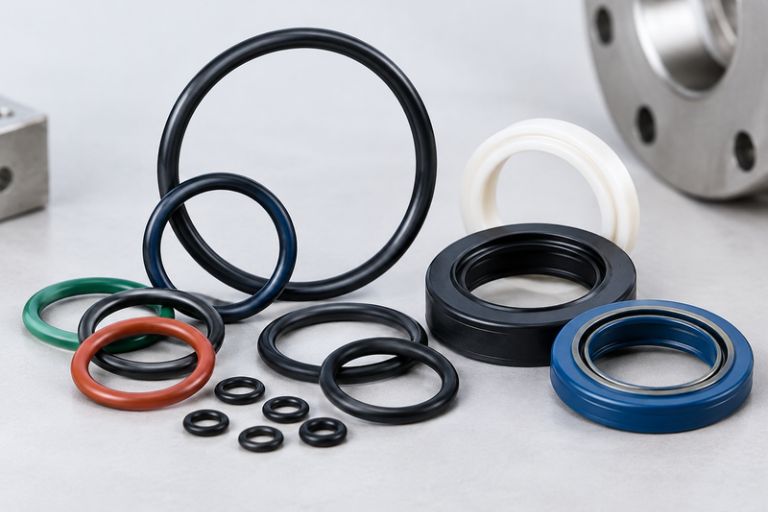
O-rings and seals are among the most widely used mechanical components in industrial systems. Despite their simple circular design, they play a critical role in preventing leakage, maintaining pressure, and protecting equipment performance.
From hydraulic systems and automotive engines to chemical processing and food-grade applications, O-rings are engineered to operate under demanding pressure, temperature, and chemical conditions.
Selecting the correct material, hardness, and groove design determines whether a system runs reliably — or fails prematurely.
What is an O-Ring?
An O-ring is a circular elastomeric sealing element with a round cross-section. It is designed to sit inside a precision-engineered groove and compress between two mating surfaces to prevent the escape of fluids or gases.
When compressed, the O-ring deforms elastically, filling microscopic gaps between surfaces and creating a tight seal.
How O-Rings Work
The working principle of an O-ring is based on elastic deformation and contact pressure.
When installed in a gland:
- The O-ring is compressed between two surfaces.
- Internal system pressure pushes the O-ring against the low-pressure side.
- This increases contact force and improves sealing performance.
However, excessive pressure, incorrect sizing, or poor material selection can cause:
- Extrusion
- Compression set
- Chemical degradation
- Thermal failure
Proper engineering selection is critical.
Static vs Dynamic O-Ring Seals
| Feature | Static O-Ring | Dynamic O-Ring |
| Movement | No relative motion | Relative motion between parts |
| Stress Type | Compression only | Compression + friction |
| Material Requirement | Moderate resilience | High wear resistance |
| Lubrication | Minimal | Essential |
| Risk of Failure | Lower | Higher |
Dynamic applications (rotary shafts, pistons, cylinders) require materials with excellent abrasion resistance and lower friction properties. Additionally, selecting the right O rings and seal solutions is essential to ensure smooth operation, minimize wear, and maintain long-term performance in such demanding conditions.
Common O-Ring Materials and Their Applications
| Material | Temperature Range | Strength | Typical Use |
| Nitrile (NBR) | -35°C to 120°C | Oil resistant | General industrial, automotive |
| Silicone | -50°C to 200°C | Flexible | Food, medical, outdoor |
| Viton (FKM) | -26°C to 205°C | Chemical & heat resistant | Chemical, oil & gas |
| EPDM | -50°C to 135°C | Water/steam resistant | Plumbing, HVAC |
| PTFE | -200°C to 260°C | Chemical inert | Extreme chemical applications |
| Metal O-Rings | Very high temp & pressure | Extreme durability | Aerospace, heavy industry |
Material compatibility with fluid media is more important than temperature rating alone.
High-Temperature O-Ring Selection
High-temperature applications such as engines, turbines, and chemical plants require materials that resist:
- Thermal degradation
• Hardening
• Compression set
Viton, Silicone, Fluorosilicone, and PTFE are commonly used in such environments. Selection depends on both heat exposure and chemical contact.
High-Pressure O-Rings
Under high pressure, extrusion becomes the primary failure mode.
Solutions include:
- Using harder compounds (90 Shore A)
• Adding backup rings
• Selecting filled PTFE
• Designing correct gland clearance
Without proper design, even high-performance materials will fail prematurely.
Industry-Specific O-Ring Applications
Automotive & Engines
Used in fuel systems, oil systems, turbo assemblies.
Chemical Processing
Require resistance to acids, solvents, and aggressive chemicals.
Food & Beverage
Must meet food-grade regulatory standards.
Aerospace
Must handle extreme temperature shifts and pressure changes.
Plumbing & HVAC
Require water and steam compatibility.
Manufacturing Methods
O-rings are typically manufactured using:
- Compression molding
• Transfer molding
• Injection molding
• Extrusion (for cord stock)
Each method affects precision, cost, and production scale.
Final Thoughts
Although O-rings appear simple in design, their performance depends heavily on correct engineering selection. Temperature range, fluid compatibility, pressure rating, movement type, and groove dimensions must all be considered before choosing a sealing solution.
An incorrect material or size can lead to leakage, system downtime, equipment damage, and increased maintenance costs.
For reliable sealing performance, it is always recommended to evaluate operating conditions carefully and select a material grade suited specifically for the application environment.
If you are unsure which O-ring material or specification suits your system, consult with a sealing expert to ensure long-term durability and optimal performance.