
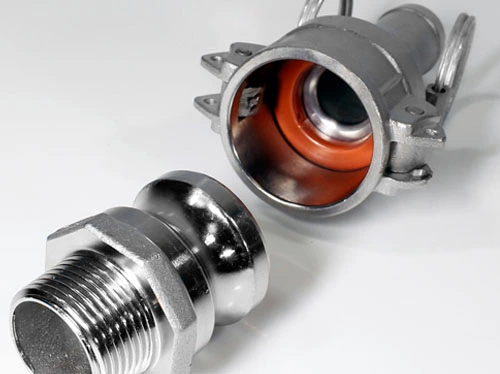
Sealing solutions are critical in maintaining pressure, preventing leakage, and protecting system integrity across industrial applications. Two of the most widely used sealing components are gaskets and O-rings. While both serve the same fundamental purpose—preventing fluid or gas leakage—their design, operating mechanism, and ideal applications differ significantly.
Understanding these differences is essential to selecting the right sealing solution for your system.
What Is a Gasket?
A gasket is a flat or shaped sealing component placed between two stationary mating surfaces to prevent leakage. It is typically compressed between flanges, housings, or covers to create a tight barrier.
Unlike O-rings, gaskets are not limited to circular shapes. They can be custom-cut to match complex surface geometries and are ideal for sealing larger surface areas.
Gaskets are commonly manufactured from:
- Rubber compounds (Nitrile, EPDM, Silicone)
- Composite materials
- Graphite
- Metal or metal-reinforced materials
Their primary sealing mechanism relies on surface compression across a wide contact area.
What Is an O-Ring?
An O-ring is a circular elastomeric sealing element with a round cross-section. It is designed to fit into a precision-engineered groove (gland) and compress between cylindrical or circular mating components.
O-rings seal through radial compression and pressure-assisted deformation. When internal pressure increases, it pushes the O-ring against the low-pressure side of the groove, improving sealing force.
O-rings are typically used in:
- Hydraulic systems
- Pneumatic cylinders
- Pumps
- Valves
- Automotive assemblies
Their simple geometry makes them highly efficient for circular sealing applications.
Key Differences Between Gaskets and O-Rings
|
Feature |
Gasket |
O-Ring |
|
Shape |
Flat or custom-shaped |
Circular (torus-shaped) |
|
Surface Type |
Flat mating surfaces | Cylindrical or circular grooves |
|
Pressure Handling |
Moderate to high | High-pressure capable |
| Movement | Static applications |
Static and dynamic |
|
Installation |
Requires alignment & bolting | Inserted into groove |
|
Cost |
Higher for custom shapes | Economical for standard sizes |
| Reusability | Typically single-use |
Limited reuse depending on wear |
Sealing Mechanism Comparison
Gaskets create a seal by compressing across a wide surface area. They compensate for flange imperfections and surface irregularities.
O-rings create a seal through elastic deformation and radial pressure. They are more pressure-reactive—meaning the higher the system pressure (within limits), the tighter the seal.
However, excessive pressure without backup support can cause O-ring extrusion.
When to Use a Gasket
A gasket is the better choice when:
- You are sealing flat flange surfaces
- The mating surface is irregular or non-circular
- The sealing area is large
- The application is purely static
- Extreme surface coverage is required
Common industries include:
- Power generation
- Automotive engine housings
- EV battery enclosures
- Food processing equipment
- Industrial flanges
When to Use an O-Ring
An O-ring is ideal when:
- The sealing surface is circular or cylindrical
- High-pressure containment is required
- The system includes dynamic movement
- Space is limited
- Cost efficiency is important
O-rings are commonly found in:
- Hydraulic pistons
- Fuel systems
- Pneumatic actuators
- Valve assemblies
- Medical devices
Material Considerations
Material compatibility plays a major role in selection.
|
Condition |
Recommended O-Ring Material | Recommended Gasket Material |
|
Oil & Fuel |
Nitrile, Viton |
Nitrile, Fluorocarbon |
|
High Temperature |
Viton, Silicone, PTFE | Graphite, Metal, PTFE |
|
Water & Steam |
EPDM |
EPDM, Silicone |
| Chemicals | PTFE, FKM |
PTFE, Composite |
| Food Grade | Silicone, EPDM (FDA) |
Silicone, EPDM (FDA) |
Incorrect material selection is one of the leading causes of seal failure.
Installation and Maintenance
O-rings are generally easier and faster to install due to their groove-based design. However, gland dimensions must be accurate to avoid compression set or extrusion.
Gaskets require uniform bolt torque distribution to ensure even compression. Improper tightening can result in uneven sealing and leakage.
Maintenance cycles for both depend heavily on temperature, pressure, and media exposure.
Cost Comparison
O-rings are usually more economical for small sealing areas and standardized applications.
Encapsulated Gaskets become cost-effective when sealing larger or irregular surfaces where O-rings are not practical.
However, lifecycle cost should always be considered rather than just initial purchase price.
Final Thoughts
Although gaskets and O-rings share the same purpose—preventing leakage—they are not interchangeable solutions.
O-rings excel in circular, high-pressure, and dynamic applications where space efficiency and pressure-reactive sealing are required. Gaskets are better suited for flat, large, or irregular mating surfaces where full-area compression sealing is needed.
Selecting the correct sealing component depends on:
- Surface geometry
- Pressure conditions
- Temperature range
- Chemical compatibility
- Installation constraints
Choosing the wrong solution can result in premature leakage, system downtime, and increased maintenance costs.
For critical applications, always evaluate operating parameters carefully and consult sealing specialists to ensure optimal long-term performance.