
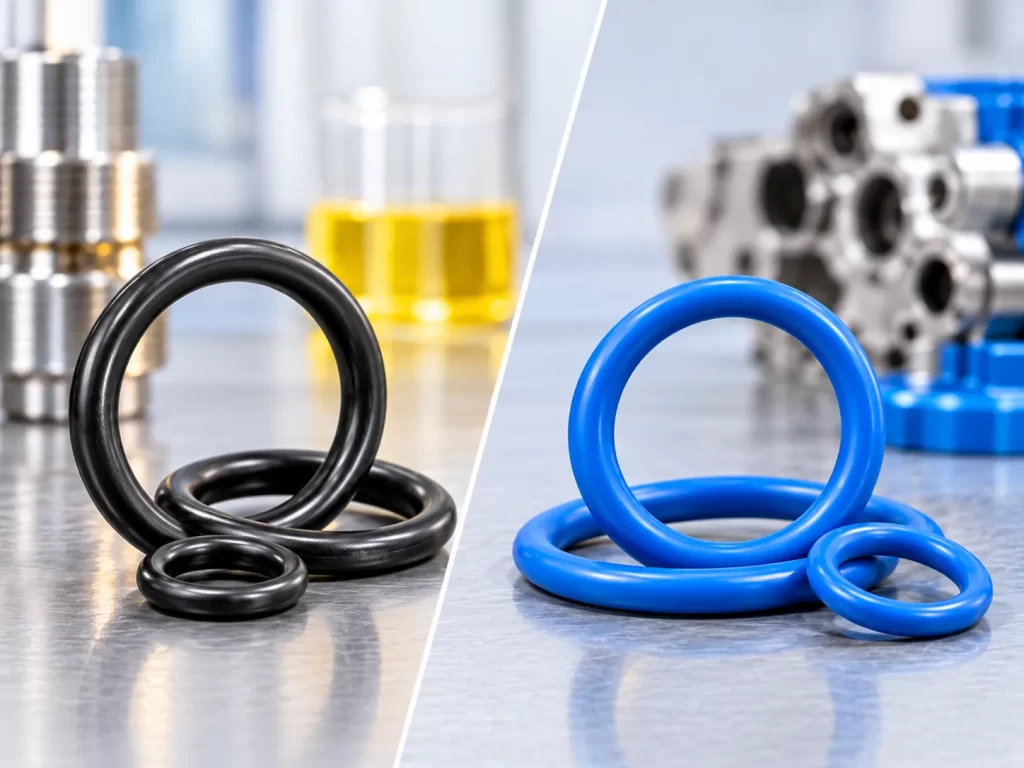
Choosing the right O-ring material can affect sealing reliability, service life, and maintenance needs. Viton and nitrile are both widely used elastomers, but they have different strengths.
A Viton Oring is often considered for applications involving higher temperatures, fuels, oils, and many aggressive fluids. Nitrile, also called NBR, is commonly selected for general oil and fuel sealing where its material properties match the service conditions.
The choice should not be based only on the name of the material. Temperature, fluid compatibility, pressure, movement, and gland design all matter. KAF Vulcan helps industrial teams assess sealing requirements and select suitable O-ring solutions based on the application.
What Are Viton and Nitrile O-Rings?
Viton is a common trade name associated with fluor elastomer materials, often referred to as FKM. These materials are valued for their resistance to heat and many oils, fuels, and chemicals.
A viton Oring uses this elastomer in a circular sealing profile. It can be used in static and selected dynamic applications when the operating conditions suit the material.
Nitrile O-rings are made from NBR. They are widely used in hydraulic and pneumatic equipment, machinery, pumps, and general industrial systems.
Nitrile offers good resistance to mineral oils and many petroleum-based fluids. Its suitability can change with the specific fluid, temperature, and compound used.
How Do Their Material Properties Differ?
The main difference lies in how each elastomer responds to the service environment.
| Factor | Viton/FKM O-Ring | Nitrile/NBR O-Ring |
| Heat resistance | Generally higher | Moderate to good, depending on compound |
| Mineral oils | Good | Good |
| Fuels | Good for many applications | Good for many applications |
| Chemical resistance | Broad, but media-specific | More limited for some chemicals |
| Water-based service | Depends on grade | Often suitable, depending on conditions |
| Low-temperature flexibility | Can be limited by grade | Can be better with suitable grades |
| Typical use | Automotive, chemical, process equipment | Hydraulics, pneumatics, machinery |
When is a Viton O-Ring A Better Choice?
A Viton Oring can be a strong option when the seal is exposed to higher temperatures or fluids that may challenge some general-purpose elastomers.
Typical applications can include:
- Fuel systems
- Oil and lubricant systems
- Chemical processing equipment
- Automotive equipment
- Pumps and valves
- Process machinery
- High-temperature sealing points
Temperature limits should always be checked against the exact FKM compound. Not every Viton formulation has the same properties.
Chemical compatibility also needs to be reviewed for the actual media. Concentration and temperature can change how a material performs.
When Does Nitrile Make More Sense?
Nitrile is often chosen when the application involves oils, hydraulic fluids, or general machinery service and does not require the wider chemical resistance of some fluor elastomer compounds.
It can be suitable for:
- Hydraulic systems
- Pneumatic equipment
- Oil seals
- Pumps
- General industrial machinery
- Low to moderate temperature applications
Cost can also be a consideration when the operating environment does not require a higher-specification elastomer.
However, selecting nitrile only because it is commonly used can create problems. The actual fluid and temperature should still be checked before final selection.
Viton Vs Nitrile: Which Performs Better with Heat?
Heat is one of the main reasons engineers consider fluor elastomer O-rings.
A Viton Oring generally offers better high-temperature capability than standard NBR compounds. This can make it useful around engines, process equipment, and systems where elevated temperatures are expected.
Nitrile can perform well within its rated temperature range. Problems can occur when an NBR seal is exposed to temperatures beyond its intended service range for long periods.
Before selecting either material, engineers should check:
- Normal operating temperature
- Maximum temperature
- Exposure duration
- Fluid temperature
- Pressure at the sealing point
Short temperature spikes and continuous exposure should not be treated as the same operating condition.
How Do They Compare for Chemical Exposure?
Chemical compatibility is more complex than simply asking whether an O-ring is “chemical resistant.
Different chemicals affect elastomers in different ways. Temperature can also change the result.
FKM is compatible with many oils, fuels, and industrial fluids. However, it is not suitable for every chemical or service condition.
NBR can work well with many petroleum-based fluids. Its compatibility can become more limited with certain chemicals, solvents, and other aggressive media.
For critical equipment, compatibility data for the exact compound should be checked before purchase.
What Other O-Ring Materials Should Be Considered?
Material selection does not always end with Viton or nitrile.
A Silicone Oring can be considered where its temperature flexibility and material characteristics suit the application. It is used in several industrial and processing applications, but its compatibility must still be checked against the process media.
For applications that need a fluoropolymer sealing surface, PTFE sealing rings may also be considered. PTFE has different mechanical behaviour from elastomers, so its use depends heavily on the gland design and sealing conditions.
For large static sealing applications, vulcanised Orings can provide a continuous ring made from joined elastomer cord. This can be useful when standard moulded O-ring sizes do not meet the required dimensions.
Each option addresses a different set of operating conditions.
What Should Engineers Check Before Choosing?
The right O-ring should be selected after reviewing the complete application.
Key factors include:
- Fluid: Identify the exact liquid or gas.
- Temperature: Check normal and maximum operating temperatures.
- Pressure: Review the pressure at the sealing point.
- Movement: Establish whether the seal is static, reciprocating, or rotary.
- Gland: Check groove dimensions, squeeze, and clearance.
- Installation: Consider stretching, twisting, and surface condition.
- Service life: Consider exposure time and maintenance intervals.
A Viton vs nitrile which is better comparison only makes sense after these factors are known.
A material that performs well in one machine may not be the right choice in another.
Choose The O-Ring Based on the Working Conditions
The question of Viton vs nitrile which is better does not have one answer. Viton/FKM can be a suitable choice for applications that need higher heat resistance and compatibility with many oils, fuels, and industrial fluids.
Nitrile can be a practical option for many oil-based, hydraulic, pneumatic, and general machinery applications where its operating limits are suitable.
A Viton Oring should be selected after checking the exact temperature, media, pressure, and sealing arrangement. Alternative materials may be more suitable when those conditions call for a different sealing approach.
KAF Vulcan provides industrial sealing solutions for plant and process applications. They focus on application-specific material selection across O-rings, encapsulated seals, vulcanised Orings, and other sealing products. Their technical approach helps engineering and procurement teams review the sealing requirement before selecting the product. Contact KAF Vulcan to discuss an application or request a suitable sealing solution.