
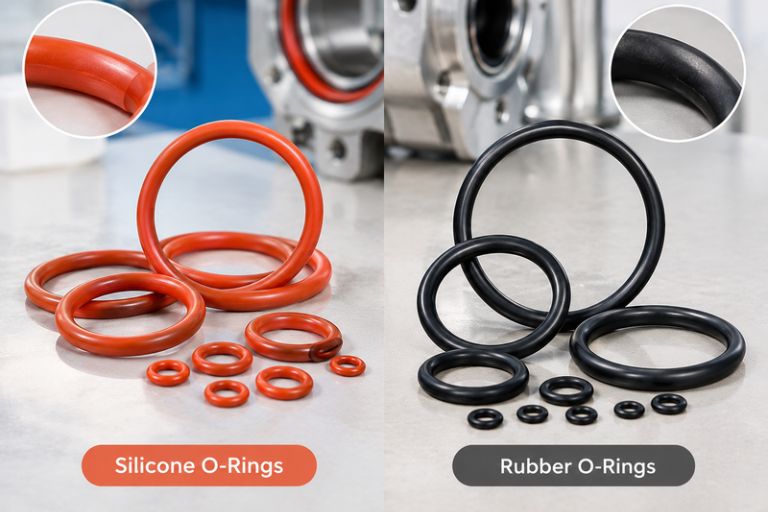
When selecting an O-ring for industrial sealing applications, one of the most common questions is whether to use silicone or rubber. At first glance, both appear similar. They are flexible, circular seals designed to prevent leakage between mating surfaces. However, their material composition, performance characteristics, and application suitability differ significantly.
Choosing the wrong material can lead to premature seal failure, leakage, equipment damage, and repeated maintenance. Understanding the differences between silicone O-rings and conventional rubber O-rings helps ensure long-term sealing reliability.
The right choice depends on temperature range, chemical exposure, mechanical stress, environmental conditions, and whether the application is static or dynamic.
Understanding Silicone O-Rings
Silicone O-rings are manufactured from silicone elastomers, typically classified as VMQ (Vinyl Methyl Silicone). Silicone is widely known for its excellent thermal stability and flexibility across extreme temperatures.
One of the defining characteristics of silicone is its ability to remain flexible at very low temperatures while also maintaining performance at elevated temperatures.
Typical operating range:
| Property | Silicone O-Rings |
| Minimum Temperature | Approximately -60°C |
| Maximum Continuous Temperature | Approximately 200–230°C |
| Short-Term High Exposure | Up to 300°C (grade dependent) |
Silicone O-rings are commonly used in:
- Food processing equipment
- Medical devices
- Electronics enclosures
- Automotive cooling systems
- Outdoor applications exposed to UV and ozone
Silicone is highly resistant to weathering, ozone, and ultraviolet radiation. This makes it ideal for long-term outdoor exposure.
However, silicone has relatively low tear strength and moderate abrasion resistance. It is generally better suited for static applications rather than aggressive dynamic sealing.
Understanding Rubber O-Rings
The term “rubber O-rings” typically refers to elastomers such as NBR (Nitrile), EPDM, or FKM (Fluorocarbon). Each rubber type offers different advantages.
For comparison purposes, nitrile (NBR) is often considered the standard rubber O-ring material.
Typical nitrile operating range:
| Property | Nitrile (NBR) O-Rings |
| Minimum Temperature | Approximately -30°C |
| Maximum Continuous Temperature | Approximately 100–120°C |
NBR is widely used because it offers good oil resistance, mechanical strength, and cost efficiency. It performs well in hydraulic systems, fuel systems, and general industrial applications.
Other rubber types extend performance:
EPDM offers strong resistance to steam and weathering.
FKM (Viton type) offers improved high-temperature and oil resistance up to approximately 200°C.
Therefore, “rubber O-ring” performance depends on the specific elastomer selected.
Key Differences Between Silicone and Rubber O-Rings
Temperature Resistance
Silicone clearly outperforms standard rubber like NBR at both low and high temperature extremes.
| Feature | Silicone | Standard Rubber (NBR) |
| High Temperature | Excellent | Moderate |
| Low Temperature | Excellent | Limited |
| Thermal Cycling | Very stable | Moderate |
For applications involving ovens, hot air systems, or cold environments, silicone is typically preferred.
Chemical Resistance
Chemical compatibility varies significantly depending on rubber type.
Silicone performs well against:
Ozone
UV exposure
Weathering
However, silicone is not ideal for:
Fuels
Petroleum oils
Hydrocarbons
Nitrile rubber, on the other hand, performs well in oil and fuel environments but does not tolerate high heat as effectively.
FKM rubber provides strong resistance to oils, fuels, and high temperature, making it more suitable for aggressive chemical environments compared to silicone.
Mechanical Strength and Durability
Rubber O-rings such as NBR or FKM generally offer better tear resistance and abrasion strength than silicone.
| Mechanical Property | Silicone | NBR |
| Tear Strength | Moderate to Low | High |
| Abrasion Resistance | Moderate | High |
| Compression Set | Moderate | Good |
In dynamic applications involving friction, vibration, or mechanical wear, rubber materials usually outperform silicone.
Silicone is softer and may tear or wear faster under mechanical stress.
Flexibility and Elastic Recovery
Silicone remains flexible across a very wide temperature range. This is especially important in low-temperature environments where rubber materials may harden.
However, in terms of compression set resistance under high mechanical stress, certain rubber compounds like FKM may perform better over long periods.
Environmental Resistance
Silicone O-rings are highly resistant to:
Ozone
UV radiation
Weathering
Aging
Rubber materials vary in environmental resistance. EPDM performs well outdoors, but NBR is less resistant to ozone exposure unless specially formulated.
For outdoor sealing applications, silicone or EPDM are typically preferred over nitrile.
Application-Based Comparison
The best choice depends on the application environment.
| Application Type | Recommended Material |
| Food & Medical Equipment | Silicone |
| Outdoor Sealing | Silicone or EPDM |
| Fuel Systems | NBR or FKM |
| High-Temperature Engine Seals | FKM |
| Low-Temperature Environments | Silicone |
| General Industrial Hydraulic Systems | NBR |
No single material is universally superior. Each material is optimized for specific operating conditions.
When to Choose Silicone O-Rings
Silicone O-rings are ideal when:
Wide temperature range is required
UV or ozone exposure is high
Flexibility at low temperatures is critical
The application is static
FDA or medical compliance is necessary
They are not recommended for high-pressure dynamic systems involving fuel or heavy mechanical wear.
When to Choose Rubber O-Rings
Rubber O-rings such as NBR or FKM are better suited when:
The application involves oils or fuels
Mechanical durability is required
Abrasion resistance is important
The system operates under moderate temperatures
Cost efficiency is a priority
FKM rubber becomes the preferred choice when higher temperatures and chemical resistance are needed without moving to premium materials like FFKM.
Cost Considerations
Silicone is typically more expensive than standard nitrile rubber but less expensive than high-performance materials like FKM or FFKM.
NBR is often the most cost-effective option for general industrial use.
Selecting a higher-cost material only makes sense when operating conditions demand it.
Final Verdict: Which Is the Best Choice?
There is no universal “best” between silicone and rubber O-rings.
Silicone is superior in extreme temperature environments and outdoor exposure conditions. Rubber materials like NBR and FKM provide stronger mechanical durability and better resistance to fuels and oils.
The correct decision should be based on:
Operating temperature
Chemical exposure
Mechanical stress
Environmental conditions
Regulatory requirements
Making a material decision based purely on temperature without considering chemical compatibility or motion conditions can result in premature failure.
For critical systems, material selection should always align with the specific demands of the application. Partnering with experienced manufacturers like KAF, a trusted mechanical seal manufacturer, ensures you get the right O-ring material and sealing solution tailored to your exact operating conditions.