
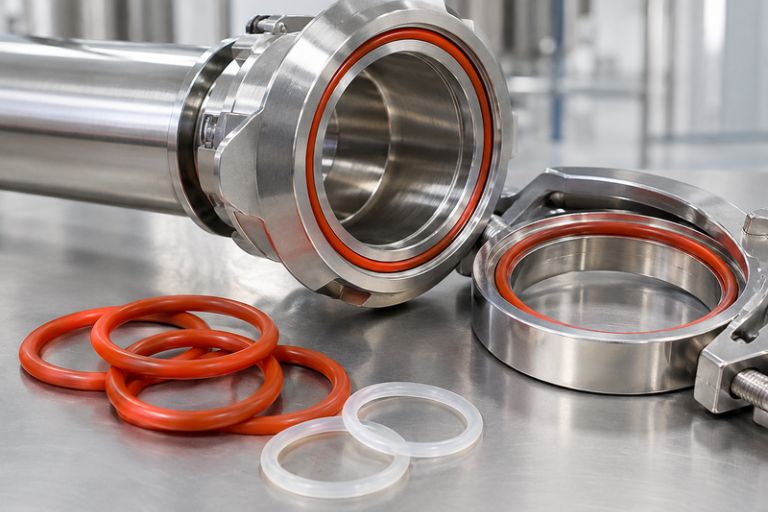
Silicone O-rings are among the most widely used sealing components in modern industry. While the fundamental design of the O-ring has remained unchanged for decades, material advancements have significantly expanded its applications. Silicone, in particular, has become a preferred elastomer in environments where temperature extremes, environmental exposure, and regulatory compliance are critical.
Silicone O-rings are not universal solutions for every sealing challenge. However, in the right conditions, they provide reliable performance where many traditional rubber materials would fail. Understanding their uses begins with understanding their material behavior.
Why Silicone Is Used in O-Rings
Silicone elastomers are based on siloxane polymer chains. This molecular structure provides exceptional thermal stability and flexibility across a broad temperature range.
Typical performance range:
| Property | Silicone O-Rings |
| Minimum Temperature | Approximately -60°C |
| Maximum Continuous Temperature | Approximately 200–230°C |
| Short-Term High Exposure | Up to 300°C (grade dependent) |
Unlike many conventional rubber materials, silicone maintains flexibility at extremely low temperatures. At the same time, it resists degradation under continuous heat exposure.
In addition to temperature stability, silicone offers strong resistance to ozone, ultraviolet radiation, and general environmental aging. These properties make it especially suitable for outdoor and exposed applications.
Primary Uses of Silicone O-Rings
High-Temperature Static Sealing
One of the most common uses of silicone O-rings is in high-temperature static applications. These include sealing between flanges, covers, housings, and enclosures where movement is minimal.
In ovens, heating chambers, engine compartments, and high-temperature lighting systems, silicone O-rings maintain sealing performance without hardening or cracking.
Unlike standard nitrile rubber, which begins to degrade at elevated temperatures, silicone remains stable and flexible.
Low-Temperature Applications
Silicone performs exceptionally well in cold environments. Many elastomers lose elasticity and become brittle below -30°C. Silicone, however, remains flexible even in sub-zero and cryogenic-adjacent environments.
This makes silicone O-rings suitable for:
- Outdoor industrial equipment
- Refrigeration systems
- Aerospace applications
- Cold-storage sealing
Flexibility at low temperatures ensures that sealing force is maintained even when metal components contract.
Food and Beverage Processing
Silicone O-rings are widely used in food processing equipment due to their non-toxic properties and regulatory compliance options.
Food-grade silicone materials are commonly formulated to meet FDA and other international standards. Their resistance to heat and cleaning chemicals makes them suitable for equipment exposed to sterilization cycles.
They are commonly used in:
- Mixing equipment
- Filling machines
- Processing lines
- Sanitary fittings
In these systems, maintaining hygiene while withstanding heat is essential.
Medical and Pharmaceutical Equipment
Silicone is biologically stable and non-reactive. For this reason, silicone O-rings are often selected in medical devices and pharmaceutical manufacturing systems.
They are used in:
- Fluid handling systems
- Autoclaves
- Diagnostic equipment
- Sealing enclosures in medical instruments
Silicone’s ability to tolerate repeated sterilization cycles is a key advantage in these applications.
Electrical and Electronic Enclosures
Silicone provides excellent electrical insulation properties. Combined with its resistance to ozone and UV radiation, this makes it suitable for sealing electronic housings and outdoor control panels.
In electronics manufacturing, silicone O-rings help protect sensitive components from moisture and dust ingress.
Automotive Cooling and Air Systems
In automotive applications, silicone O-rings are often used in cooling systems and air-handling components where high temperatures and weather exposure occur.
While silicone is not ideal for fuel contact, it performs well in systems involving:
Hot air flow
Engine compartment heat exposure
Cooling circuits
For fuel systems, other materials such as FKM are typically preferred.
Strengths and Limitations in Real Applications
Silicone O-rings offer clear advantages, but they also have limitations that must be considered.
Performance Comparison
| Property | Silicone | NBR (Standard Rubber) | FKM |
| High Temperature Resistance | Excellent | Moderate | Excellent |
| Low Temperature Flexibility | Excellent | Limited | Good |
| Fuel Resistance | Poor | Good | Excellent |
| Ozone/UV Resistance | Excellent | Moderate | Good |
| Tear Strength | Moderate | High | High |
| Abrasion Resistance | Moderate | High | High |
Silicone excels in temperature and environmental resistance. However, it does not perform well in fuel-rich or petroleum-heavy environments. Its tear strength and abrasion resistance are lower compared to some other elastomers.
For dynamic, high-friction applications, silicone may wear more quickly.
When Silicone O-Rings Should Not Be Used
Silicone is not recommended for:
Direct fuel exposure
High-pressure hydraulic systems
Heavy dynamic sealing
Severe abrasion environments
In such cases, materials like FKM, HNBR, or specialty elastomers may provide better durability.
Why Silicone Remains Popular
Despite its limitations, silicone remains one of the most commonly specified O-ring materials. This is because many industrial systems operate within temperature extremes but do not involve aggressive hydrocarbons or heavy dynamic movement.
Its stability, non-toxicity, environmental resistance, and thermal range make it highly versatile.
For applications where:
Temperature range is broad
Environmental exposure is significant
Compliance is required
The application is primarily static
Silicone O-rings offer a reliable and cost-effective solution.
Final Thoughts
Silicone O-rings are widely used across industries because they provide stable sealing performance under extreme temperatures and harsh environmental exposure. As an o ring and seal solution, they are particularly effective in food processing, medical equipment, electronics, and high-temperature static systems.
However, they are not universal replacements for all rubber materials. When fuel resistance, high abrasion strength, or heavy dynamic performance is required, alternative elastomers may be more appropriate.
Selecting silicone O-rings should be based on a clear evaluation of temperature conditions, chemical exposure, mechanical stress, and compliance requirements.
When properly applied, silicone O-rings deliver long-term reliability in environments where conventional rubber seals struggle to perform.