
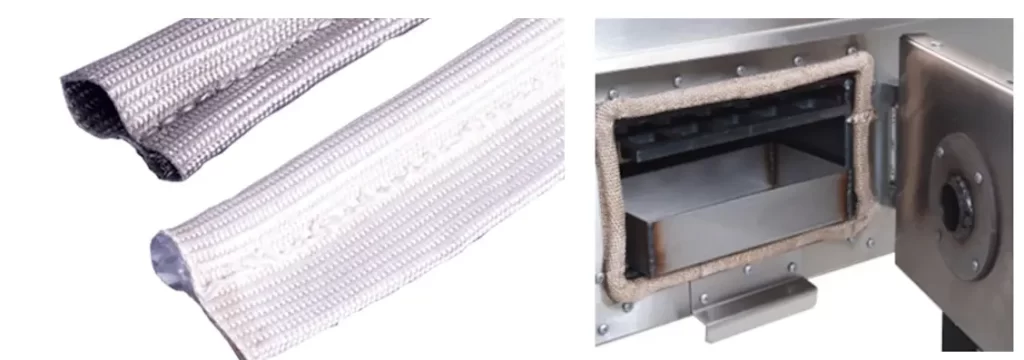
What is a Tadpole Gasket?
A tadpole gasket is a specialized high-temperature sealing solution designed primarily for thermal insulation and sealing of furnace doors, oven panels, boiler access doors, ducts, and expansion joints.
Its name comes from its distinctive shape. When viewed in cross-section, the gasket resembles a tadpole a round bulb connected to a flat tail. This bulb-and-tail configuration allows it to provide effective sealing under extreme thermal conditions.
Unlike flat gaskets or braided ropes, a tadpole gasket is engineered specifically for environments where heat, expansion, vibration, and mechanical movement must be controlled simultaneously.
Understanding the Structure of a Tadpole Gasket
A tadpole gasket is not a single-material product. It is a composite structure made of:
- A heat-resistant outer cover
- A resilient core material
- A stitched or fused tail for attachment
The outer cover forms the cylindrical “bulb” portion of the gasket. The remaining edges of the fabric are extended and stitched together to create the flat “tail” section, which is secured to doors, frames, or panel joints.
This design allows the bulb to compress when a door or panel closes, forming a tight thermal seal.
Why the Bulb-and-Tail Design Matters
The bulb acts as the primary sealing element. When compressed, it conforms to surface irregularities and blocks heat, gases, and dust from escaping.
The tail provides anchoring stability. It is typically fixed using clamps, channels, bolts, or adhesive bonding systems. This ensures the gasket remains properly positioned even under thermal expansion and repeated door movement.
This structure makes tadpole gaskets ideal for industrial heating equipment where flat gaskets would fail.
Materials Used in Tadpole Gaskets
Material selection determines the gasket’s performance. Both the outer jacket and the internal core are chosen based on temperature and operating conditions.
Outer Jacket Materials
The outer layer must withstand continuous exposure to high temperatures. Common materials include:
|
Material |
Maximum Continuous Temperature |
Typical Use |
|
Fiberglass Fabric |
~550°C | Industrial ovens and ducts |
|
Silica Fabric |
~1000°C |
High-temp furnaces |
|
Ceramic Fiber Fabric |
~1260°C |
Extreme heat applications |
| Stainless Steel Mesh Reinforced Fabric | High mechanical durability |
Abrasive conditions |
In some cases, the outer fabric may be coated with silicone, graphite, or vermiculite to enhance abrasion resistance and reduce heat loss.
Core Materials
The internal core determines compression and flexibility.
|
Core Type |
Purpose |
|
Fiberglass Rope |
Standard thermal insulation |
|
Stainless Steel Mesh |
High resilience and durability |
| Ceramic Fiber Rope |
Very high-temperature sealing |
| Silicone Rubber |
Lower heat, higher flexibility |
The correct combination of jacket and core ensures performance stability.
Temperature Capabilities of Tadpole Gaskets
The temperature range depends entirely on the selected materials.
|
Jacket Type |
Continuous Temperature Rating |
|
Fiberglass |
Up to 550°C |
|
Silica |
Up to 1000°C |
| Ceramic |
Up to 1260°C |
| Specialized Industrial Systems |
Higher with engineering support |
It is important to evaluate both radiant heat and direct flame exposure when selecting a tadpole gasket.
Where Are Tadpole Gaskets Used?
Tadpole gaskets are primarily used in high-temperature industrial environments.
Common applications include:
- Furnace doors
- Kiln openings
- Boiler access panels
- Ductwork joints
- Expansion joints
- Industrial ovens
- Fire-rated door systems
- Glass and metal processing equipment
In these applications, preventing heat loss improves energy efficiency and safety.
Advantages of Tadpole Gaskets
Tadpole gaskets offer several operational benefits.
They provide superior thermal insulation compared to flat gaskets. Their compressible bulb design accommodates uneven mating surfaces. They tolerate thermal expansion and contraction without losing sealing performance.
Because they are customizable, they can be manufactured in specific diameters, tail widths, and core densities.
They also provide resistance to:
- Mechanical abrasion
- Steam exposure
- Chemical vapors
- Thermal cycling
Limitations of Tadpole Gaskets
Despite their strengths, tadpole gaskets are not universal sealing solutions.
They are not suitable for high-pressure fluid sealing. Their primary function is thermal and environmental sealing, not hydraulic containment.
Improper installation can reduce performance. If the tail is not securely fixed, the gasket may shift during operation.
Material degradation can occur if exposed to temperatures beyond rated limits or in highly corrosive chemical environments.
Selecting the correct material combination is critical.
Installation Considerations
Installation plays a major role in gasket life.
The mounting surface must be clean and smooth. Sharp edges should be avoided as they can cut the fabric.
The tail must be properly secured using:
- Retaining strips
- Bolted channels
- Clamping systems
- High-temperature adhesives (where appropriate)
Proper compression is important. Excessive compression can deform the bulb and reduce longevity.
Tadpole Gasket vs Rope Gasket – Comparison
|
Feature |
Tadpole Gasket | Rope Gasket |
|
Shape |
Bulb with tail | Round braided |
|
Mounting |
Fixed tail system | Press-fit groove |
|
Heat Retention |
Higher |
Moderate |
| Surface Compensation | Excellent |
Limited |
| Customization | Highly customizable |
Standard sizes |
| Best For | Furnace & industrial doors | Fireplace doors & light-duty sealing |
Tadpole gaskets offer greater structural stability and improved thermal performance in industrial settings.
Industries That Rely on Tadpole Gaskets
Tadpole gaskets are widely used in:
- Power generation facilities
- Steel and metal processing plants
- Glass manufacturing
- Petrochemical plants
- Refineries
- Industrial baking ovens
- Waste incineration systems
These industries require reliable thermal containment to improve efficiency and prevent heat loss.
How to Select the Right Tadpole Gasket
When specifying a tadpole gasket, consider:
- Maximum operating temperature
- Continuous vs intermittent exposure
- Mechanical abrasion level
- Steam or chemical exposure
- Required compression force
- Mounting method
- Size and geometry
Proper engineering evaluation ensures long service life.
Final Thoughts
A tadpole gasket is a highly engineered thermal sealing solution designed for high-temperature industrial environments. Its unique bulb-and-tail structure allows it to deliver effective insulation while accommodating mechanical movement and thermal expansion.
Material selection, installation accuracy, and application conditions all influence performance. For this reason, many mechanical seal manufacturers also emphasize proper sealing design and material compatibility when recommending thermal sealing components like tadpole gaskets.
When chosen correctly, tadpole gaskets reduce heat loss, improve energy efficiency, and enhance operational safety in demanding industrial systems.