
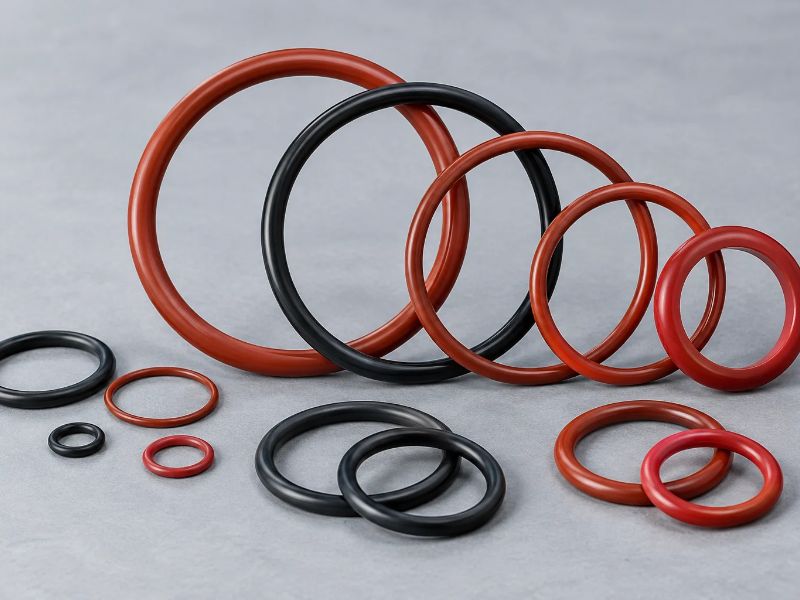
High-temperature O-rings are used when standard sealing materials start failing due to heat. In real industrial environments, heat rarely comes alone. It usually comes with pressure, chemical exposure, vibration, thermal cycling, and long operating hours. When a seal fails under these conditions, the result is not only leakage but also downtime, product loss, safety risks, and repeated maintenance.
A high-temperature O-ring is not simply an O-ring that “doesn’t melt.” It is a carefully selected material compound that can retain elasticity, maintain compression set stability, and resist degradation at elevated temperatures. In most industrial applications, O-rings are considered “high temperature” when the operating environment is consistently above roughly 150°C, especially when the temperature is continuous rather than occasional.
The real advantage of choosing a proper high-temperature O-ring is reliability. It keeps equipment running longer, reduces the frequency of seal replacement, and maintains process stability in harsh operating conditions.
Why Heat Causes O-Rings to Fail
Elastomer seals are designed to seal by elastic deformation. When you compress an O-ring inside a groove, it creates sealing force against the mating surfaces. Heat gradually reduces that ability.
At high temperatures, elastomers begin to harden and lose elastic recovery. Over time, they take a permanent “set,” meaning they remain flattened instead of springing back. That reduced recovery leads to micro-leakage, and later, complete seal failure. Heat also accelerates oxidation and chemical breakdown, which can crack the O-ring surface or change the material’s volume.
This is why selecting a high-temperature compound is a preventive decision. It addresses both the physical damage from heat and the long-term aging of elastomers.
The Core Advantages of High-Temperature O-Rings
Better Sealing Stability at Elevated Temperatures
The primary advantage is that high-temperature O-rings maintain their sealing force when exposed to heat for long periods. This is especially important in continuous-process industries like chemical manufacturing, refining, semiconductor production, and pharmaceutical operations where equipment runs for long cycles without shutdown.
When the correct material is used, the O-ring resists permanent deformation and continues to seal under thermal expansion and contraction of metal components.
Lower Compression Set and Longer Service Life
Compression set is one of the biggest failure modes in high heat. Materials designed for high temperature typically offer improved compression set resistance, which means they maintain their shape and sealing force longer.
This reduces maintenance frequency and helps avoid repeated shutdowns just to replace seals.
Reduced Risk of Leakage, Downtime, and Rework
Industrial leakage is expensive. It impacts safety, production time, equipment condition, and in many industries, compliance. High-temperature O-rings reduce the likelihood of seal breakdown, which means fewer emergency stoppages and fewer recurring issues.
Wider Operating Window Under Pressure and Thermal Cycling
Many industrial systems experience fluctuating conditions. A seal may face low temperature during startup and high temperature during operation. Thermal cycling creates stress because metals expand and contract, changing sealing squeeze and gland conditions.
High-temperature materials are engineered to tolerate thermal cycling better than standard elastomers, which helps maintain consistency across varying operating phases.
Better Compatibility With Harsh Media at High Temperature
At high temperatures, chemicals become more aggressive. A media that is stable at 30°C can attack elastomers at 180°C. Many high-temperature O-ring materials are also selected because they handle oils, fuels, solvents, acids, or cleaning chemicals better at elevated temperatures.
This is a major advantage in process industries, refineries, pharmaceutical cleaning cycles, and semiconductor wet processes.
Advantages by Material Type
Not all high-temperature O-rings deliver the same benefits. Each material has strengths depending on whether your main problem is heat, chemicals, steam, fuels, or dynamic friction.
Material Comparison Table
| Material | Typical High-Temp Range | Key Advantages | Common Use |
| FKM (Viton type) | Up to ~200°C | Strong for oils, fuels, hydrocarbons; good compression set | Automotive, oil & gas, refineries |
| Silicone (VMQ) | Up to ~200°C | Very good thermal stability and flexibility; excellent for static seals | Food, medical, ovens, enclosures |
| PTFE | Up to ~250°C | Near-universal chemical resistance; very wide temp range | Aggressive chemicals, static sealing |
| FFKM | ~260°C and above (grade dependent) | Best chemical resistance + high temp performance; low compression set | Semiconductor, pharma, harsh chemical |
| HNBR | Up to ~140°C | Very strong wear resistance and durability; improved heat vs NBR | Automotive, mechanical systems |
| FEP/PFA Encapsulated | FEP ~205°C; PFA ~260°C | Chemical resistance of fluoropolymer with elastomer elasticity | Pharma, chemical, high purity sealing |
This is why the phrase “best high-temperature O-ring” depends on your application. For oils and fuels, FKM is usually the practical choice. For very aggressive chemicals and high purity, FFKM or encapsulated designs are often the right direction. For static high heat with flexibility, silicone is commonly used.
Where High-Temperature O-Rings Deliver the Most Value
High-temperature O-rings are chosen not only because heat exists, but because reliability matters. They are widely used in engines, pumps, valves, compressors, reactors, mixers, and rotating equipment where sealing failure can disrupt operations.
They are also common in industries like chemical processing, oil & gas, pharmaceutical manufacturing, food processing, semiconductor equipment, refrigeration systems, and industrial machinery.
Even in applications that are not “high heat” all the time, high-temperature O-rings add value when heat spikes occur and standard materials fail unexpectedly.
When High-Temperature O-Rings Are Not Enough
It is also important to be clear: heat resistant materials are not a cure-all if the application design is wrong.
If a gland is over-compressing the O-ring, friction is excessive, or sharp edges damage the seal during installation, even high-performance materials will fail. If the application is highly dynamic and the seal is constantly sliding, frictional heat may push temperatures beyond material limits.
This is why high-temperature sealing should always consider the gland design, surface finish, correct squeeze, and the real temperature at the seal location (not just the ambient temperature).
High-Temperature O-Rings vs Encapsulated O-Rings
In many industrial systems, the challenge is not only heat but also chemical exposure. In such cases, encapsulated O-rings can offer a better balance.
| Factor | High-Temp Elastomer O-Rings | Encapsulated O-Rings (FEP/PFA) |
| Heat performance | High (material dependent) | High (FEP/PFA dependent) |
| Chemical resistance | Varies | Very high due to fluoropolymer jacket |
| Best use | Oils, fuels, heat zones | Aggressive chemicals, high purity |
| Motion suitability | Better for dynamic (FKM/FFKM) | Best for static or light movement |
For example, if the environment is chemically aggressive and near 200–260°C, encapsulated O-rings (especially PFA jacket types) may be more appropriate than a standard elastomer, depending on movement and pressure.
Final Thoughts
The biggest advantage of high-temperature O-rings is not only that they survive heat. The real advantage is that they deliver stable sealing performance when conditions become harsh and unpredictable.
They resist hardening, reduce compression set problems, maintain sealing force through thermal cycling, and offer better compatibility with harsh media at elevated temperatures. When chosen correctly, they reduce downtime, improve safety, and lower total maintenance cost.
For the best results, selection should be made based on continuous operating temperature, chemical exposure, pressure conditions, and whether the seal is static or dynamic. Many mechanical seal manufacturers also emphasize that choosing the right O-ring material is just as critical as the seal design itself. When the application involves both heat and aggressive chemicals, advanced options like FFKM or fluoropolymer-encapsulated O-rings often provide the most reliable long-term performance.