
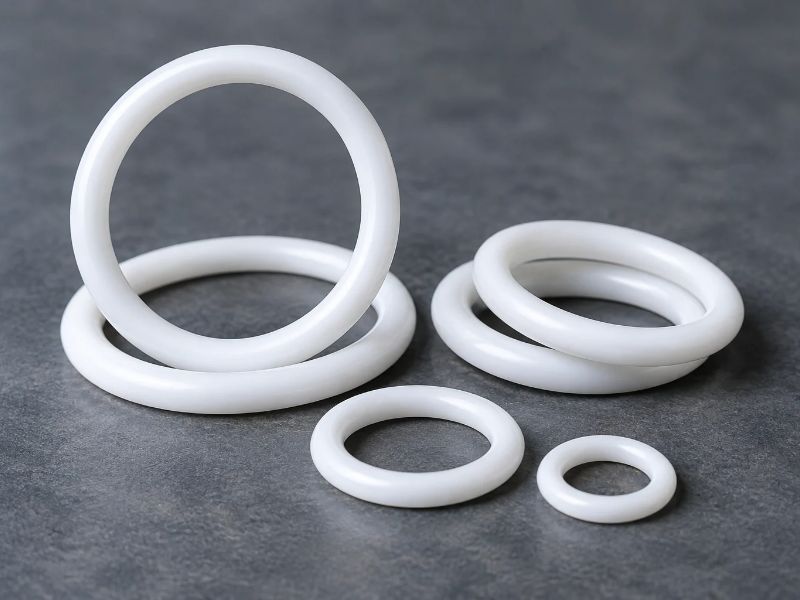
O-rings are among the most widely used mechanical sealing components in industrial systems. Their function is simple in concept: create a seal between two mating surfaces to prevent leakage of fluids or gases. However, when operating conditions involve aggressive chemicals, extreme temperatures, or long service life requirements, standard elastomer O-rings may not be suitable.
This is where PTFE O-rings become relevant.
PTFE O-rings are specialized sealing components manufactured from polytetrafluoroethylene, a high-performance thermoplastic polymer known for exceptional chemical resistance and wide temperature stability. Unlike rubber-based O-rings, PTFE O-rings behave differently under compression and require a different approach to selection and installation.
Understanding how PTFE O-rings work and when they should be used is critical for reliable sealing performance.
What Is PTFE?
Polytetrafluoroethylene (PTFE) is a synthetic fluoropolymer made from tetrafluoroethylene monomers. It is composed of carbon and fluorine atoms, forming one of the strongest molecular bonds in polymer chemistry.
This molecular structure gives PTFE several unique properties:
- High chemical inertness
- Extremely low friction coefficient
- Wide temperature capability
- Electrical insulation performance
- Resistance to moisture absorption
PTFE is widely recognized under trade names in various industries, but the fundamental material properties remain consistent across formulations.
What Are PTFE O-Rings?
PTFE O-rings are ring-shaped mechanical seals machined or molded from PTFE material. They are used in static sealing applications where chemical resistance, thermal stability, or purity requirements exceed the capabilities of elastomers.
Unlike rubber O-rings, PTFE O-rings are not elastic in the traditional sense. They do not rely on rebound properties for sealing. Instead, they depend on controlled compression within a precision-machined groove.
They are available in standard sizes such as AS568 and ISO series, as well as custom diameters and cross-sections for specialized equipment.
How PTFE O-Rings Work
PTFE O-rings function by creating a compression seal between two mating components. When installed inside a groove and compressed between surfaces, the PTFE material deforms slightly to fill gaps and block fluid passage.
However, because PTFE does not behave like rubber, its sealing mechanism differs in several important ways.
When an elastomer O-ring is compressed, it stores elastic energy and pushes back against the gland surfaces, maintaining sealing force even as pressure fluctuates.
PTFE, by contrast, undergoes plastic deformation rather than elastic deformation. Once compressed, it does not fully recover its original shape. This means:
- Proper gland design is critical
- Surface finish requirements are stricter
- Reuse after disassembly is not recommended
In pressurized systems, internal pressure assists sealing by forcing the PTFE material against the low-pressure side of the groove. This pressure-activated sealing behavior is especially useful in static flange applications.
Key Properties That Enable PTFE O-Ring Performance
Wide Temperature Capability
One of the most important characteristics of PTFE is its temperature stability.
| Temperature Property | Typical PTFE Range |
| Minimum Operating Temperature | Approximately -200°C |
| Maximum Continuous Temperature | Approximately 250°C |
| Short-Term Exposure | Higher depending on load |
At extremely low temperatures, elastomers become rigid and lose elasticity. PTFE retains structural integrity in cryogenic systems.
At elevated temperatures, PTFE resists thermal breakdown where rubber compounds may harden, crack, or degrade.
Chemical Resistance
PTFE is resistant to nearly all industrial chemicals. It performs well against:
- Strong acids
- Alkalis
- Solvents
- Hydrocarbons
- Oxidizers
This makes PTFE O-rings highly suitable for chemical processing plants, pharmaceutical systems, laboratory equipment, and semiconductor manufacturing.
Very few materials offer comparable chemical inertness.
Low Friction Characteristics
PTFE has one of the lowest coefficients of friction among solid materials. This reduces surface wear and minimizes drag between sealing surfaces.
Although PTFE O-rings are not typically recommended for high-speed dynamic applications, their low friction can be advantageous in slow-moving or static assemblies.
Dimensional Stability and Moisture Resistance
PTFE does not absorb moisture and does not degrade under UV exposure. It maintains dimensional stability over time and has a long shelf life without special storage precautions.
This makes PTFE suitable for applications requiring extended service intervals or long-term storage.
Advantages of PTFE O-Rings
The main advantages can be summarized technically as:
- Exceptional chemical compatibility
- Broad temperature resistance
- Non-reactive and FDA-compliant (virgin PTFE)
- Long shelf life
- Low friction performance
- Suitable for high-purity environments
These advantages explain why PTFE is often selected in harsh chemical and extreme temperature systems.
Limitations of PTFE O-Rings
While PTFE offers impressive properties, it is not suitable for all applications.
Because PTFE is relatively hard compared to elastomers, it does not conform easily to imperfect surface finishes. Surface roughness must be carefully controlled.
PTFE is also inelastic. Once deformed, it does not return to its original cross-section. This means PTFE O-rings are typically:
- Single-install components
- Not ideal for frequent disassembly
- Best suited for static face or flange sealing
Leakage rates may also be slightly higher compared to elastomer O-rings unless the gland design is optimized.
PTFE O-Rings vs Elastomer O-Rings
Understanding the difference helps determine suitability.
| Property | PTFE O-Rings | Elastomer O-Rings |
| Elasticity | Very low | High |
| Chemical Resistance | Extremely high | Material dependent |
| Temperature Range | Very wide | Moderate to high |
| Reusability | Not recommended | Often possible |
| Sealability on Rough Surfaces | Limited | Good |
PTFE is not an upgrade for every situation. It is a specialized material for specialized conditions.
Typical Applications of PTFE O-Rings
PTFE O-rings are commonly used in:
- Chemical reactors
- Pharmaceutical equipment
- Laboratory instrumentation
- Cryogenic systems
- High-temperature ovens
- Food processing equipment
- Semiconductor wet processing
In these environments, chemical resistance and temperature stability outweigh the need for elastic rebound.
When to Consider Alternatives
If the application involves frequent movement, high-speed rotation, or repeated opening and closing, elastomer O-rings such as FKM or silicone may perform better.
In high-pressure or highly critical applications where PTFE’s chemical resistance is required but improved sealing performance is necessary, spring-energized PTFE seals may be more suitable than solid PTFE O-rings.
Final Thoughts
PTFE O-rings provide a unique solution for sealing applications involving extreme temperature, aggressive chemicals, and high-purity environments. Their performance characteristics differ significantly from elastomer O-rings, and successful implementation depends on proper gland design and application analysis.
They are not the best choice for every sealing challenge. However, in the right application, PTFE O-rings deliver exceptional durability and chemical stability that conventional elastomers cannot match.
Selecting PTFE should be a technical decision based on operating environment, pressure conditions, and mechanical requirements.
When properly specified and installed, PTFE O-rings provide long-term, reliable performance in demanding industrial systems. Trusted manufacturers like KAF Vulcan further ensure precision-engineered O ring sealing solutions for critical applications