
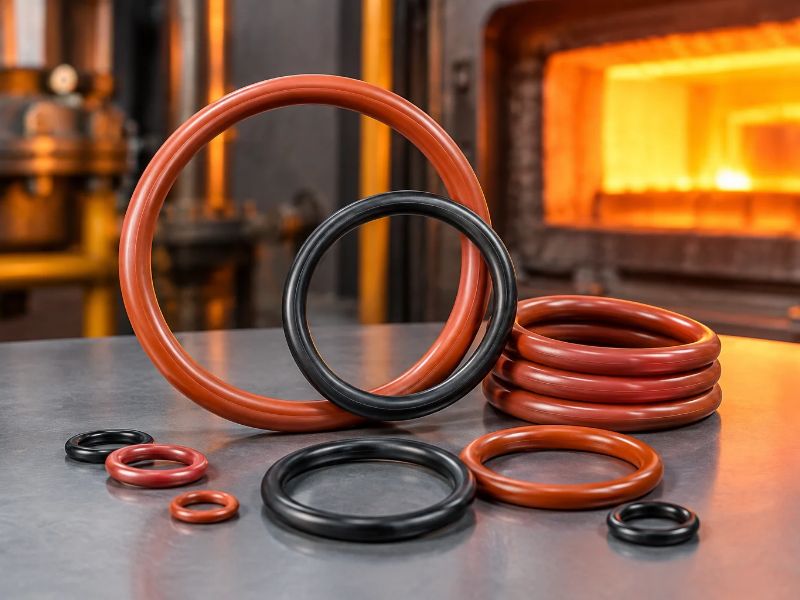
Heat is one of the most aggressive forces acting on elastomer seals. When temperatures rise beyond normal operating limits, O-rings begin to lose elasticity, harden, swell, and eventually fail. In critical industrial systems, such failure can lead to leakage, equipment shutdown, safety hazards, and costly maintenance.
Heat resistant O-rings are specifically engineered to operate in elevated temperature environments while maintaining sealing integrity. These seals are not simply “stronger rubber.” They are carefully formulated compounds designed to resist thermal degradation, maintain compression set stability, and withstand chemical exposure at high temperatures.
Understanding how heat affects elastomers and how different materials respond is essential before selecting the right sealing solution.
How High Temperature Impacts O-Rings
When exposed to heat, elastomer compounds undergo chemical and physical changes. Oxidation accelerates. Polymer chains begin to stiffen. Elastic recovery decreases. Over time, this results in permanent deformation known as compression set.
High temperatures can cause:
- Hardening and brittleness
- Loss of elasticity
- Volume expansion or shrinkage
- Cracking and surface degradation
- Reduced sealing force
Even if the seal initially performs well, prolonged exposure above its continuous temperature rating dramatically reduces service life.
Heat effects are further intensified when combined with pressure and aggressive media. Therefore, selecting a heat resistant O-ring requires evaluating temperature together with chemical and mechanical conditions.
What Defines a Heat Resistant O-Ring?
A heat resistant O-ring is one manufactured from compounds that maintain their mechanical properties at elevated temperatures.
Most standard industrial elastomers operate safely up to approximately 120–150°C. Beyond that range, specialized materials must be used.
High-temperature materials are typically categorized as follows:
| Temperature Capability | Material Class |
| Up to 200°C | FKM, Silicone |
| 200°C – 260°C | High-grade FKM, FFKM |
| Above 260°C | Premium FFKM formulations |
The correct choice depends on continuous operating temperature rather than short-term spikes.
Key Materials for Heat Resistant O-Rings
FKM (Fluorocarbon / Viton®)
FKM is one of the most widely used high-temperature elastomers in industrial sealing. It offers excellent resistance to oils, fuels, hydrocarbons, and many chemicals.
Typical temperature capability ranges up to 200°C, with specialty grades reaching slightly higher.
FKM provides good compression set resistance and strong mechanical properties, making it suitable for:
- Automotive engines
- Oil & gas equipment
- Chemical processing systems
- Fuel handling components
However, FKM has limitations in hot water and steam environments unless special formulations are selected.
Silicone (VMQ)
Silicone O-rings are known for excellent thermal flexibility. They perform well in both high and low temperatures, typically from -60°C to 200°C.
Silicone maintains flexibility at high temperatures but has lower tear strength compared to FKM. It is most effective in static sealing environments.
Common applications include:
Food processing
Medical equipment
Oven systems
Lighting assemblies
Silicone is not ideal for fuel-rich environments.
FFKM (Perfluoroelastomer)
FFKM represents the highest performance class of elastomers for extreme temperature and chemical environments.
Continuous operating temperatures may reach 260°C or higher depending on the compound.
FFKM combines:
Exceptional thermal resistance
Near-universal chemical compatibility
Very low compression set
Strong long-term sealing stability
It is commonly used in:
Semiconductor manufacturing
Pharmaceutical processing
Refineries
High-pressure chemical systems
Although more expensive, FFKM often reduces lifecycle costs in critical systems.
Comparative Overview of Heat Resistant Materials
| Material | Max Continuous Temp | Chemical Resistance | Steam Resistance | Typical Industry |
| FKM | ~200°C | Excellent (oils, fuels) | Moderate | Automotive, Oil & Gas |
| Silicone | ~200°C | Moderate | Good | Food & Medical |
| FFKM | ~260°C | Outstanding | Excellent | Pharma, Semiconductor |
This comparison highlights why material selection must consider more than temperature alone.
Compression Set: The Critical Factor in High Heat
Compression set refers to the permanent deformation of an O-ring after prolonged compression.
In high-temperature environments, materials with poor compression set resistance lose sealing force over time. Once elasticity is lost, leakage occurs even if the O-ring appears intact.
Lower compression set values correlate directly with better heat resistance.
FFKM and high-grade FKM compounds typically demonstrate superior compression set performance compared to general-purpose elastomers.
The Role of Gland Design in Heat Applications
Even the best heat resistant O-ring can fail if the groove design is incorrect.
Over-compression increases internal stress and accelerates heat buildup through friction. Under-compression reduces sealing force.
Proper gland design must account for:
- Thermal expansion
- Material hardness
- Pressure loading
- Surface finish
Heat generation from friction in dynamic applications must also be considered, as excessive friction may exceed material limits.
Chemical Exposure at Elevated Temperature
Temperature often amplifies chemical attack.
A material that performs well at room temperature may degrade rapidly when the same chemical is present at 200°C.
For example:
FKM resists oils at high temperatures but struggles in hot steam.
Silicone tolerates heat but swells in fuels.
FFKM withstands nearly all aggressive chemical media at elevated temperatures.
Chemical compatibility charts should always be reviewed together with temperature ratings.
Dynamic vs Static High-Temperature Applications
Static seals experience compression without significant movement. These applications are more forgiving when selecting heat resistant materials.
Dynamic seals face friction, movement, and heat buildup simultaneously. Not all heat resistant materials are suitable for continuous motion.
FKM often performs better than silicone in moderate dynamic systems. FFKM must be evaluated carefully depending on compound formulation and wear characteristics.
Signs of Thermal Seal Failure
Heat-related O-ring failure often presents early warning signs.
Surface cracking or hardening
Permanent flattening
Loss of elasticity
Leakage after repeated heat cycles
Recognizing these symptoms allows preventive replacement before major failure occurs.
Selecting the Right Heat Resistant O-Ring
Proper selection requires evaluating:
- Maximum continuous temperature
- Chemical environment
- Pressure levels
- Movement type
- Regulatory compliance requirements
- Service life expectations
There is no universal solution. Each application demands a tailored material decision.
Balancing performance and cost is essential. In some systems, FKM offers sufficient performance at moderate cost. In highly critical environments, FFKM becomes the safer long-term investment.
Final Thoughts
Heat resistant O-rings are not optional in high-temperature environments. They are critical components that protect equipment integrity, operational safety, and process reliability.
Understanding how different materials respond to elevated temperature and how temperature interacts with pressure and chemicals ensures proper material selection.
FKM offers strong performance for oil and fuel systems. Silicone provides thermal flexibility for static environments. FFKM delivers unmatched stability in extreme chemical and thermal applications.
Choosing the right material prevents premature failure, reduces downtime, and ensures long-term sealing performance.