
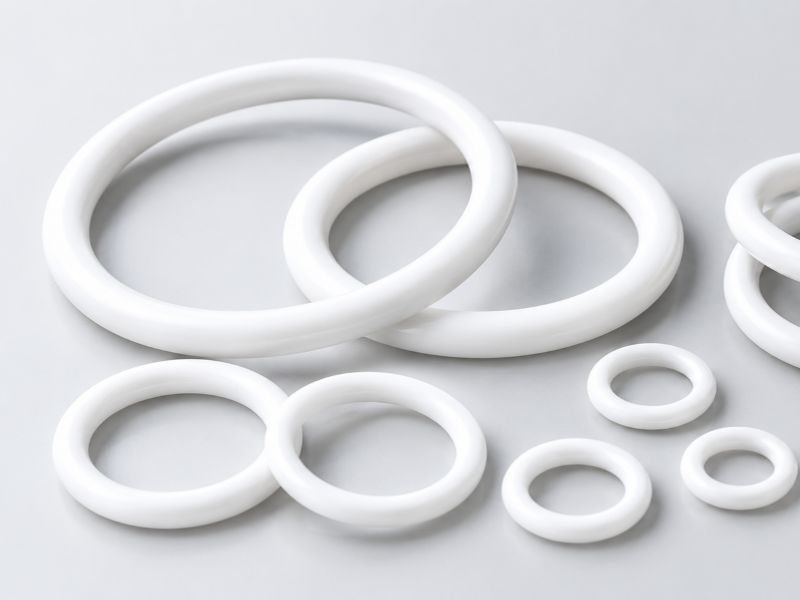
PTFE O-rings are used when conventional elastomer seals are no longer sufficient. In many industrial systems, rubber compounds begin to fail due to chemical attack, temperature extremes, or aggressive process conditions. When these limitations are reached, PTFE becomes a viable alternative.
Polytetrafluoroethylene (PTFE) is not an elastomer. It is a thermoplastic polymer with unique mechanical and chemical properties. Because of this, PTFE O-rings behave very differently from traditional rubber O-rings. Understanding both their strengths and limitations is critical before selecting them for a sealing application.
PTFE O-rings are most commonly used in chemically aggressive environments, high-temperature systems, cryogenic equipment, and applications where long-term stability is more important than flexibility.
What Makes PTFE Different from Elastomers?
Most O-rings are made from elastomeric materials such as NBR, EPDM, FKM, or silicone. These materials seal by elastic deformation they compress and rebound to maintain sealing force.
PTFE, however, does not behave like rubber. It has very low elasticity and does not return to its original shape once deformed. Instead of relying on elasticity, PTFE O-rings depend heavily on precise gland design and compression during installation.
This fundamental difference is the reason PTFE offers exceptional advantages in some applications and serious limitations in others.
Key Advantages of PTFE O-Rings
Exceptional Chemical Resistance
One of the primary reasons PTFE O-rings are selected is their near-universal chemical compatibility.
PTFE is resistant to almost all industrial chemicals, including:
Strong acids
Alkalis
Solvents
Hydrocarbons
Oxidizing agents
In environments where elastomers swell, degrade, or crack due to chemical attack, PTFE remains stable. This makes it highly suitable for chemical processing plants, refineries, pharmaceutical production systems, and laboratory equipment.
Wide Temperature Range
PTFE performs across an extremely wide temperature range compared to most elastomers.
| Property | PTFE Capability |
| Minimum Temperature | Approximately -200°C |
| Maximum Continuous Temperature | Approximately 250°C |
| Short-Term High Exposure | Higher depending on load |
At very low temperatures, most elastomers harden and lose sealing capability. PTFE, however, retains structural integrity and does not become brittle in cryogenic environments.
At high temperatures, PTFE remains chemically stable where many elastomers would degrade.
This dual capability makes PTFE suitable for both extreme cold and high heat applications.
Long Shelf Life and Aging Resistance
Unlike elastomers, PTFE does not suffer from typical aging issues such as ozone cracking or UV degradation. It does not absorb moisture, and its properties remain stable over time.
Because of this, PTFE O-rings have an almost unlimited shelf life when stored properly. There is no significant concern about material aging during storage.
Low Friction Properties
PTFE has a naturally low coefficient of friction. This reduces surface drag between the seal and mating components.
In certain static or slow-moving applications, this can reduce wear and surface damage. It also improves chemical cleaning resistance and prevents sticking in some assemblies.
FDA Compliance and Purity
Virgin PTFE is commonly used in food processing and pharmaceutical applications due to its non-reactive nature. It is suitable for high-purity environments where contamination must be avoided.
Disadvantages of PTFE O-Rings
Despite its advantages, PTFE has significant limitations that must be carefully considered.
High Hardness and Limited Sealability
PTFE is much harder than rubber materials. On the Shore D scale, PTFE measures approximately 55 Shore D, which is significantly harder than a typical 70 Shore A elastomer.
Because of this hardness, PTFE does not conform easily to imperfect surfaces. If the gland finish is rough or machining tolerances are loose, leakage may occur.
Surface finish requirements are typically stricter when using PTFE O-rings.
Inelastic Behavior
Unlike rubber, PTFE does not recover after deformation. Once compressed or stretched, it does not return to its original shape.
This means PTFE O-rings are generally:
Not reusable
Not suitable for repeated installation
Best for static face sealing applications
In applications where a seal must be removed and reinstalled frequently, PTFE is usually not recommended.
Higher Leakage Rates Compared to Elastomers
Under standard conditions, elastomer O-rings typically provide better initial sealability due to their elasticity.
PTFE O-rings may exhibit slightly higher leakage rates unless the gland design and surface finish are optimized.
This is why PTFE is often recommended only when chemical or temperature conditions demand it.
Limited Suitability for Dynamic Applications
PTFE can be used in certain low-speed applications, but it is not ideal for high-cycle dynamic systems unless properly engineered.
Because PTFE lacks elasticity, it does not compensate for wear or dimensional changes the way elastomers do.
In many dynamic or high-performance applications, spring-energized PTFE seals are preferred over solid PTFE O-rings.
PTFE O-Rings vs Elastomer O-Rings
The decision between PTFE and elastomer materials depends entirely on the application environment.
| Feature | PTFE O-Rings | Elastomer O-Rings |
| Chemical Resistance | Extremely High | Material dependent |
| Temperature Range | Very Wide | Moderate to High |
| Elastic Recovery | Very Low | Excellent |
| Reusability | Not recommended | Often possible |
| Sealability on Rough Surfaces | Limited | Good |
| Shelf Life | Nearly unlimited | Limited by aging |
PTFE is not a universal upgrade over elastomers. It is a specialized solution for specialized environments.
When PTFE Is the Right Choice
PTFE O-rings are ideal when:
- The application involves highly aggressive chemicals
- Extreme cold or high temperature is present
- Long-term chemical stability is critical
- Contamination must be minimized
- Shelf life must be extended
They are commonly found in chemical plants, pharmaceutical systems, semiconductor equipment, aerospace components, and specialized industrial machinery.
When an Alternative May Be Better
If the application involves frequent opening and closing, dynamic motion, or moderate chemical exposure without extreme temperatures, elastomer O-rings such as FKM or silicone may perform better.
In highly critical systems requiring PTFE’s chemical resistance but improved sealability and elasticity, spring-energized PTFE seals may offer a superior solution.
Final Thoughts
PTFE O-rings provide exceptional chemical resistance, outstanding temperature capability, and long-term stability. They are often the only practical solution in chemically aggressive or extreme thermal environments.
However, they are not elastic, are harder than rubber materials, and require precise installation and surface conditions. Their performance depends heavily on proper gland design and application analysis.
Selecting PTFE O-rings should be a technical decision based on environmental demands rather than a default upgrade from elastomer seals.
When applied correctly, PTFE O-rings deliver reliable performance in conditions where conventional O-rings simply cannot survive.
KAF Vulcan is a trusted manufacturer of high-performance O rings and sealing solutions, delivering precision-engineered products for demanding industrial applications. With a focus on quality and durability, KAF ensures reliable seal performance even in extreme chemical and high-temperature environments.