O-rings are used in many industrial systems to prevent leakage between two mating surfaces. While standard O-rings are available in fixed sizes, some applications need larger or custom-sized seals. This is where vulcanised O rings are useful.
These seals are made by joining elastomer cord into a continuous ring through a controlled vulcanization process. The joint must be strong and precise so that the finished seal can perform as required in its intended application.
The manufacturing process involves more than simply joining two ends of a cord. Material selection, cutting, joining, curing, inspection, and dimensional checks all have a role. Kaf Vulcan provides engineered sealing solutions for industries where these details matter.
What Is Vulcanised O-Rings?
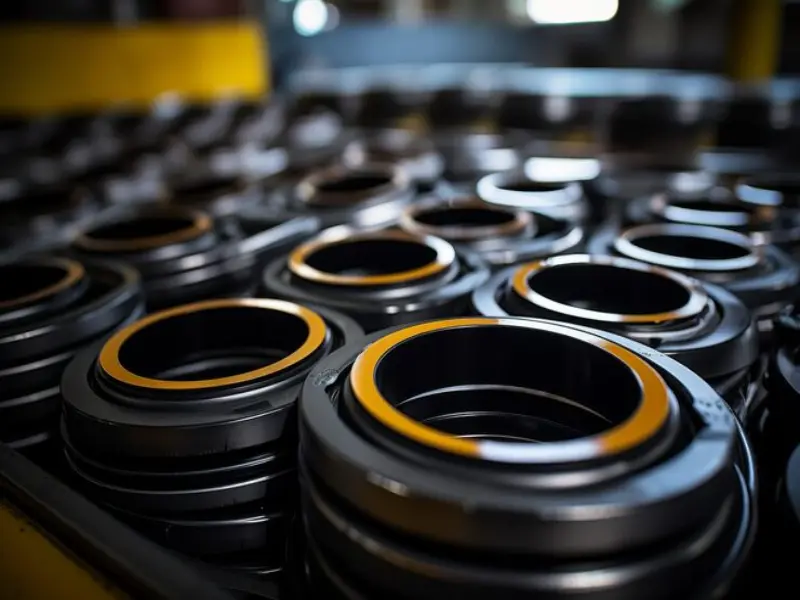
Vulcanised O rings are continuous sealing rings made from elastomer cord. They are generally used for static sealing applications and can be produced in diameters that may not be available as standard moulded O-rings.
The process allows manufacturers to create seals according to the required dimensions. This can be useful for:
- Large vessels
- Industrial covers
- Flanges
- Tanks
- Process equipment
- Custom machinery
The elastomer used for the seal is selected according to the application. Common options include EPDM, NBR, silicone, FKM, and other suitable compounds.
Why Is the Manufacturing Process Important?
The quality of a vulcanised seal depends heavily on how the joint is made.
A poorly prepared or cured joint can affect the integrity of the seal. For this reason, manufacturers need to control each stage carefully.
The process generally considers:
- Elastomer selection
- Cord preparation
- Accurate cutting
- End preparation
- Joining and vulcanisation
- Finishing
- Inspection and testing
The exact method can vary based on the material, profile, size, and application requirements.
Step 1: Selecting The Right Elastomer
Manufacturing starts with choosing an elastomer that suits the operating conditions.
The seal may come into contact with water, oils, chemicals, steam, gases, or other process media. Temperature and pressure also need to be considered.
For example, a Viton Oring may be considered for applications where FKM is suitable. A silicone Oring may be selected when the application requires the properties of silicone.
For specialised applications, cryogenic O rings and low temperature O rings require materials that can retain suitable sealing properties at low temperatures.
The material should always be selected based on the actual operating environment rather than simply the name of the elastomer.
Step 2: Preparing The Elastomer Cord
Once the material is selected, elastomer cord with the required cross-section is prepared. The cord may be available in different profiles and diameters. Its dimensions must match the required O-ring size.
The cord needs to be clean and free from damage before joining. Even small surface defects can affect the finished seal.
For vulcanised O rings, accurate cord preparation is important because the final ring must maintain the required dimensions after joining and curing.
Step 3: Cutting The Cord To Size
The cord is then cut to the length needed to form the required ring diameter.
This step requires accuracy. If the cord is too long or too short, the finished O-ring may not have the correct dimensions.
The cut ends must also be prepared correctly for the joining process. Clean, even ends help create a consistent joint.
For large, vulcanised O rings, accurate measurement becomes especially important because even a small dimensional error can affect how the seal sits in its groove.
Step 4: Joining The Two Ends
The prepared ends are brought together to form the ring. At this stage, the ends need to align correctly. The joint area must be handled carefully to avoid gaps, uneven surfaces, or contamination.
The two ends are then subjected to a controlled vulcanisation process. Heat and pressure help the elastomer bond at the joint.
The purpose is to create a continuous ring while retaining the required properties of the original elastomer.
Step 5: Vulcanisation Creates the Joint
Vulcanisation is the key stage in manufacturing vulcanised O rings.
During this process, the joint is exposed to controlled heat and pressure for a defined period. The conditions depend on the elastomer compound and manufacturing requirements.
Proper control is important. If the process is not suitable for the material, the joint may not achieve the required properties.
Once the process is complete, the joined section becomes part of the continuous O-ring.
Step 6: Finishing The Joint
After vulcanisation, the joint area may require finishing.
Any excess material or uneven edges are carefully removed. The finished area should have a suitable surface and profile for the intended sealing application.
This is particularly important for larger vulcanised O rings, where the seal may be installed over a large flange or vessel opening.
The finished seal is then checked for visible defects.
Step 7: Inspection And Quality Checks
Manufacturing does not end when the ring is formed. Inspection helps confirm that the seal meets the required specifications.
Depending on the application, checks may include:
- Inside diameter
- Cross-section
- Overall dimensions
- Joint appearance
- Surface condition
- Material identification
- Visual defects
Additional testing may be required based on the customer’s specifications or application.
This level of inspection is important for vulcanised O rings used in industrial equipment where sealing reliability is critical.
How Material Choice Changes The Final Seal
The manufacturing process may be similar, but the final seal can behave differently depending on the elastomer.
A Viton Oring and a silicone Oring, for example, have different material properties. They should not be treated as interchangeable without checking application requirements.
The same applies to cryogenic O rings and low temperature O rings. Low-temperature service can place specific demands on elastomer flexibility and sealing behaviour.
For this reason, engineers should consider:
- Temperature range
- Process media
- Pressure
- Static or dynamic service
- Seal dimensions
- Equipment design
Where Are Vulcanised O-Rings Used?
Because they can be manufactured in custom diameters, vulcanised O rings are useful across several industrial sectors.
Common applications include:
- Chemical processing equipment
- Water treatment systems
- Pharmaceutical equipment
- Food processing machinery
- Marine systems
- Industrial tanks
- Large flanges and covers
- Process equipment
They can also be used alongside other sealing products. A plant may use a Viton Oring for one application, a silicone Oring for another, and vulcanised O rings for large static seals.
Getting The Right Seal for the Application
The manufacturing quality of an O-ring matters, but so does correct product selection. Vulcanised O rings are useful when equipment requires custom or large-diameter static seals. Their performance depends on factors such as elastomer selection, dimensions, joint quality, and operating conditions.
Specialised options such as a Viton Oring, silicone Oring, cryogenic O rings, and low temperature O rings can be considered when their material properties match the application.
Kaf Vulcan supplies engineered sealing solutions for industrial applications. They work with customers to understand equipment and operating requirements before recommending a suitable product. Their range supports different sealing needs across process, chemical, pharmaceutical, food, marine, and other industries. Businesses can contact Kaf Vulcan to discuss an application, request technical guidance, or enquire about a suitable sealing solution.