
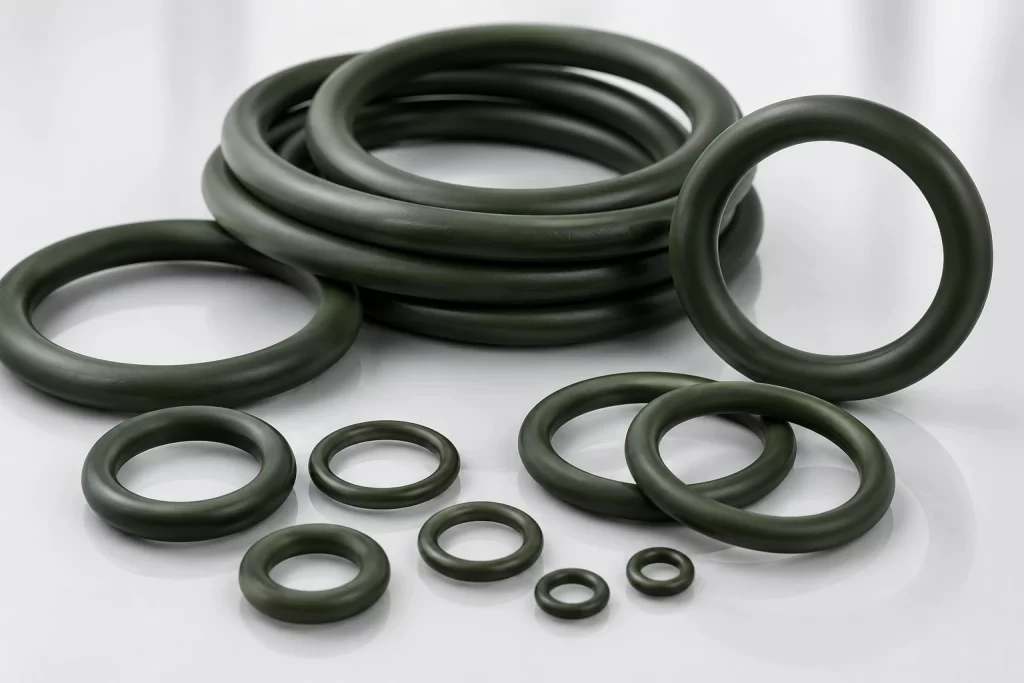
Viton O-rings are widely used when standard rubber seals struggle with heat, aggressive fluids, or long service intervals. In many industrial systems, the O-ring is a small component but it controls a big risk: leakage, contamination, loss of pressure, and unplanned downtime. That is why Viton (commonly referred to as FKM fluoroelastomer) is often selected for sealing in demanding environments such as fuel handling, chemical processing, rotating equipment, and high-temperature assemblies.
This guide explains what Viton O-rings are, how they work, what types exist, where they are used, and how to select the right grade for real operating conditions.
What are Viton O-Rings?
A Viton O-ring is a circular elastomer seal made from a fluoroelastomer material (FKM). It seals by compressing between two mating surfaces and blocking the path for fluid or gas to escape. The key difference is the material: Viton/FKM is engineered to resist high temperatures and many chemicals that attack conventional rubber.
In practical terms, Viton O-rings are chosen when the application includes:
- Elevated temperature exposure for long periods
- Oils, fuels, solvents, and aggressive media
- Need for long life with reduced maintenance
- Harsh outdoor conditions (ozone, UV, weathering)
Why Viton is used for O-rings
Viton’s value comes from its chemical structure. The fluorine content in FKM improves resistance to heat and chemical attack, reduces swelling in many oils and fuels, and helps the seal retain properties over time.
Typical performance profile
| Property | What it means in the field | Viton / FKM performance (general) |
| Heat resistance | Less hardening/cracking at high temps | Strong |
| Fuel & oil resistance | Less swelling and softening | Strong |
| Chemical resistance | Better survival in solvents and aggressive media | Strong (application-specific) |
| Compression set resistance | Better ability to “spring back” after compression | Strong to very strong (grade dependent) |
| Weather/ozone resistance | Better in outdoor or engine-bay environments | Strong |
| Low temperature flexibility | Ability to seal at sub-zero temps | Moderate (special grades improve this) |
Note: Exact limits vary by grade and compound. For engineering-critical applications, material selection should be validated against the specific media and temperature profile.
How Viton O-rings work
The working principle is the same as other O-rings, but Viton’s material properties allow it to keep sealing under harsher conditions.
When installed in a groove (gland) and compressed, the O-ring deforms elastically and fills surface imperfections. The sealing force comes from:
Initial squeeze created by compression during assembly
System pressure energization, where pressure pushes the O-ring tighter into the sealing surfaces (in many designs)
Elastic recovery, where the material maintains contact even as temperature and pressure fluctuate
If a seal fails, it is usually not because the concept is wrong. It is typically due to one of these causes:
- Wrong material compatibility with the fluid
- Excessive temperature (hardening, cracking, compression set)
- Over-compression (flattening, permanent deformation)
- Extrusion at high pressure due to poor gland design or no backup ring
- Installation damage (cuts, nicks, twisting)
Types and grades of Viton O-rings
In industry discussions, “Viton” is often used as a broad label, but there are meaningful differences between types/grades. Many references categorize Viton into variants such as Viton A, B, and F, mainly differing in fluorine content and chemical resistance profile.
Common Viton family types
| Type | General positioning | Where it’s typically used |
| Viton A | General-purpose FKM | Oils, fuels, general chemical service, standard industrial sealing |
| Viton B | Improved fluid/chemical resistance | More aggressive fluids, higher chemical exposure than general-purpose |
| Viton F | Enhanced performance in fuel-rich environments | Fuel systems, aromatics, aggressive hydrocarbon exposure |
Your sales/engineering approach can be: first match the operating temperature, then match the fluid chemistry, then confirm motion type (static vs dynamic), then validate gland design.
Material construction and what affects performance
Even within the same “type,” Viton compounds can behave differently because manufacturers tune formulas using curing systems and fillers.
Curing systems (why it matters)
| Curing system | What it typically influences | Why you care |
| Bisphenol cure | Often strong chemical and heat performance, good compression set | Good for long-life sealing in oils/chemicals |
| Peroxide cure | Often better for certain chemical profiles and improved resistance in some environments | Useful when standard cure systems struggle |
Fillers and additives
Fillers like carbon black or silica can increase strength, improve wear resistance, and enhance compression set performance. Pigments and stabilizers can also support identification and aging resistance. In practice, this is why two “Viton 75 Shore A” O-rings from different sources may not perform the same in a harsh plant environment.
Types of Viton O-rings by application requirement
Instead of only thinking “Viton A/B/F,” many buyers evaluate Viton O-rings by the condition they are built for.
| Variant style (common market language) | What it focuses on | Typical use cases |
| High-temperature Viton O-rings | Heat stability and compression set resistance | Engine zones, hot pumps, chemical process lines |
| Low-temperature Viton O-rings | Improved flexibility at low temps | Cold storage, outdoor winter exposure, refrigeration-adjacent equipment |
| Fuel-grade Viton O-rings | Resistance to fuels and hydrocarbon blends | Fuel injectors, fuel pumps, refinery systems |
| Chemical-resistant Viton O-rings | Resistance to aggressive solvents/chemicals | Chemical plants, dosing systems, certain solvent services |
Applications of Viton O-rings
Viton is selected where heat + fluid exposure combine. Below is a practical view of where Viton O-rings fit well.
Automotive and transport
Viton O-rings are common in fuel and engine-related assemblies because they handle oils and fuels better than standard rubber and maintain properties in high engine temperatures.
Oil and gas
In upstream and downstream operations, seals see hydrocarbons, pressure cycling, and high temperature zones. Viton is often used in valves, pumps, meters, and service kits where durability matters.
Chemical processing
Many process fluids attack conventional elastomers. Viton is frequently used in pumps, reactors, pipelines, and valve systems, especially where solvents and chemical blends are present.
Pharmaceutical and industrial manufacturing
Some environments need stable sealing under cleaning cycles and process fluids (compatibility must be verified). In these sectors, material traceability and consistent quality are often as important as the elastomer itself.
Advantages and limitations of Viton O-rings
Viton’s biggest strengths are also the reason it is priced higher than standard rubber. The right way to justify Viton is not cost-per-piece, but cost of failure and replacement frequency.
Advantages
Viton O-rings are valued because they typically provide longer service life in heat and chemical exposure, resist swelling in many oils and fuels, and offer stable sealing performance over time.
Limitations
Viton is not the best universal answer. In particular, very low temperature flexibility can be a limitation unless a low-temp grade is selected. Certain fluids can still be problematic depending on the specific compound and service temperature. For steam/hot water and certain chemical families, the grade selection must be done carefully.
Selection checklist (practical, not theoretical)
When your customer asks “Should we use Viton?”, the best workflow is:
Step 1: Confirm temperature
What is the continuous operating temperature and what are the short spikes?
Step 2: Confirm media
What exactly touches the seal? Oil type, fuel type, solvent type, concentration, cleaning chemicals.
Step 3: Confirm motion
Static flange seal? Reciprocating? Rotary? Dynamic applications may require different hardness, surface finish, and sometimes backup rings.
Step 4: Confirm pressure and gland design
High pressure may require backup rings to prevent extrusion, especially if clearances are high.
Step 5: Confirm standards and sizes
If the customer needs AS568, BS, ISO 3601 sizes, ensure supply consistency and tolerance control.
Final Thoughts
Viton O-rings are a reliable sealing choice when heat, fuels, oils, and chemically aggressive environments make standard rubber materials fail early. Their biggest strength is consistency—Viton tends to hold its sealing properties longer in demanding service, which reduces leakage risk and unplanned stoppages.
At the same time, Viton should not be selected just because it is “premium.” The right selection depends on the real operating temperature, the exact media in contact with the seal, pressure conditions, and whether the application is static or dynamic. In many cases, the correct grade and hardness, along with a proper gland design (and backup rings where needed), matters as much as the material itself.
If you want long-term sealing performance in harsh conditions, Viton is often the right direction—provided compatibility and operating limits are confirmed for your specific application.
Additionally, selecting the appropriate o ring and seal material plays a crucial role in achieving optimal performance, longevity, and resistance to demanding operating conditions across various industries.