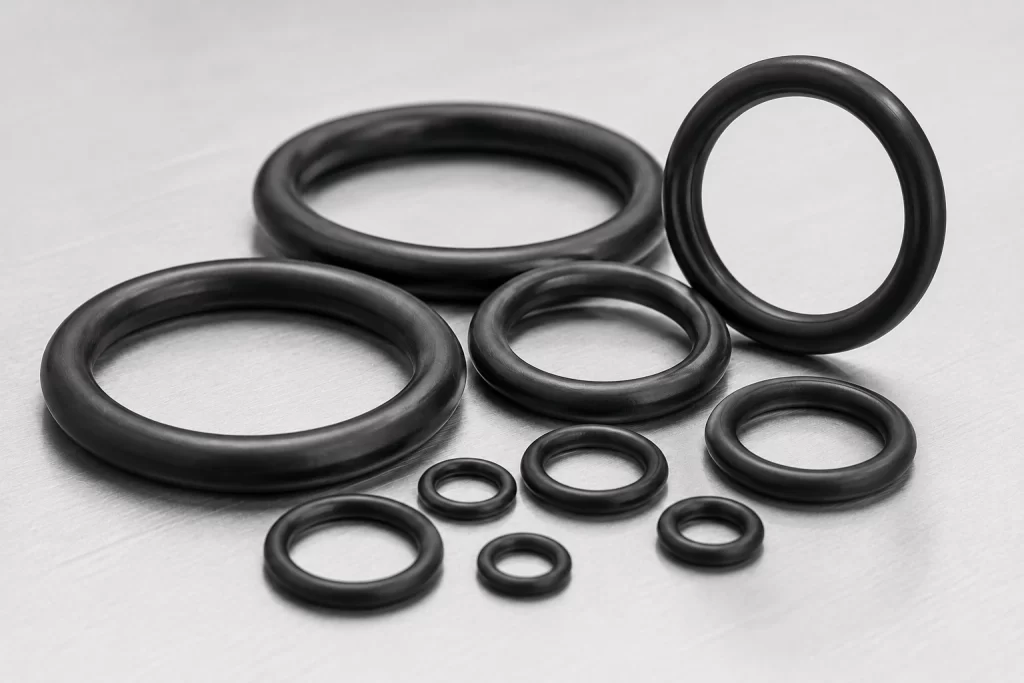
When selecting an O-ring material for industrial sealing, two of the most commonly compared elastomers are Viton® (FKM) and Nitrile (NBR). Both are widely used in hydraulic systems, automotive assemblies, oil and gas equipment, and general industrial machinery. However, they are designed for very different operating conditions.
Choosing between Viton® and Nitrile is not about selecting the “better” material. It is about selecting the material that matches your temperature range, chemical exposure, pressure conditions, and budget constraints.
Understanding the core differences between these materials helps prevent premature seal failure, leakage, and costly downtime.
Understanding Nitrile (NBR) O-Rings
Nitrile rubber, also known as Buna-N or NBR, is one of the most widely used sealing materials in the world. It is valued for its balance of cost-effectiveness, oil resistance, and mechanical strength.
Typical operating characteristics:
| Property | Nitrile (NBR) |
| Temperature Range | -30°C to 100–120°C |
| Oil Resistance | Excellent |
| Fuel Resistance | Good |
| Abrasion Resistance | High |
| Cost | Low to Moderate |
Nitrile performs especially well in applications involving petroleum-based oils and hydraulic fluids. It also offers good tensile strength and abrasion resistance, making it suitable for dynamic systems.
Because of its affordability and reliability, nitrile is often the default choice for general-purpose industrial sealing.
However, nitrile has limitations. It does not perform well at elevated temperatures for extended periods. It also has limited resistance to ozone and UV exposure unless specially formulated.
Understanding Viton® (FKM) O-Rings
Viton® is a brand name for fluoroelastomer (FKM), designed to withstand aggressive chemicals and high temperatures. It is commonly used in demanding environments where nitrile would fail.
Typical operating characteristics:
| Property | Viton® (FKM) |
| Temperature Range | -20°C to 200–230°C |
| Oil Resistance | Excellent |
| Fuel Resistance | Excellent |
| Chemical Resistance | Very High |
| Cost | Higher than Nitrile |
Viton® maintains sealing integrity at significantly higher temperatures compared to nitrile. It also provides superior resistance to fuels, acids, and many harsh chemicals.
For applications in automotive engines, chemical processing plants, aerospace systems, and oil & gas operations, Viton® is often the preferred material.
However, Viton® is not ideal for very low temperatures unless specialized grades are used.
Temperature Comparison
Temperature is often the deciding factor.
| Temperature Performance | Nitrile | Viton® |
| Low Temperature | Better flexibility | Moderate |
| High Temperature | Limited | Excellent |
| Continuous Heat Stability | Moderate | Very High |
If your application operates above 120°C regularly, nitrile may harden, lose elasticity, and develop compression set. In such cases, Viton® provides greater long-term reliability.
Chemical Resistance Comparison
Both materials resist oils, but their performance diverges with aggressive chemicals.
Nitrile performs well with:
Petroleum oils
Hydraulic fluids
Diesel fuels
Viton® performs well with:
Aromatic hydrocarbons
Strong acids
Chemical solvents
High-temperature fuels
Aggressive automotive fluids
If the application involves aggressive chemical exposure or high-temperature fluids, Viton® is generally the safer option.
Mechanical Strength and Wear
Nitrile often offers better abrasion resistance and tear strength in certain applications. It is frequently used in dynamic hydraulic systems where mechanical wear is a concern.
Viton®, while chemically superior, can be slightly less abrasion-resistant than nitrile depending on formulation.
For heavy mechanical wear at moderate temperatures, nitrile may actually outperform Viton®.
Cost Considerations
Cost is another major factor in material selection.
| Factor | Nitrile | Viton® |
| Material Cost | Lower | Higher |
| Lifecycle Cost in High-Temp Applications | Higher (due to failure) | Lower |
| Replacement Frequency | Moderate | Lower in harsh environments |
Nitrile is more economical upfront. However, in high-temperature or chemically aggressive systems, premature failure may lead to higher maintenance costs.
Viton® costs more initially but often provides longer service life in demanding environments.
Application-Based Guidance
Nitrile is typically preferred for:
Hydraulic systems
General industrial equipment
Fuel transfer systems at moderate temperatures
Cost-sensitive projects
Viton® is typically preferred for:
Automotive engine components
Oil & gas extraction systems
Chemical processing equipment
High-temperature sealing applications
Aerospace systems
The decision must consider both operating environment and total cost of ownership.
When Not to Use Each Material
Nitrile should not be used in:
High-temperature continuous exposure above 120°C
Strong acid environments
Outdoor exposure without protection
Viton® should not be used in:
Very low temperature applications without specialized grades
Applications requiring strong resistance to certain ketones or hot water/steam unless properly formulated
Material compatibility charts should always be reviewed before final selection.
Final Verdict: Which Should You Choose?
The choice between Viton® and Nitrile depends entirely on your operating conditions.
Choose Nitrile if your application involves petroleum-based oils at moderate temperatures and cost efficiency is a priority.
Choose Viton® if your system operates at elevated temperatures or involves aggressive fuels and chemicals where long-term durability is critical.
Neither material is universally superior. The correct selection balances temperature range, chemical compatibility, mechanical stress, and budget.
In sealing applications, material selection is not just about performance—it is about preventing failure before it happens.
Choosing the right O ring and seal is equally critical to ensure reliable performance and long-term durability in demanding conditions.